
Working on site—whether as a Stage Manager, Production Manager, or crew member—
is not a job defined by formal qualifications or fixed right answers.
The same applies to everyone who steps into a live production environment.
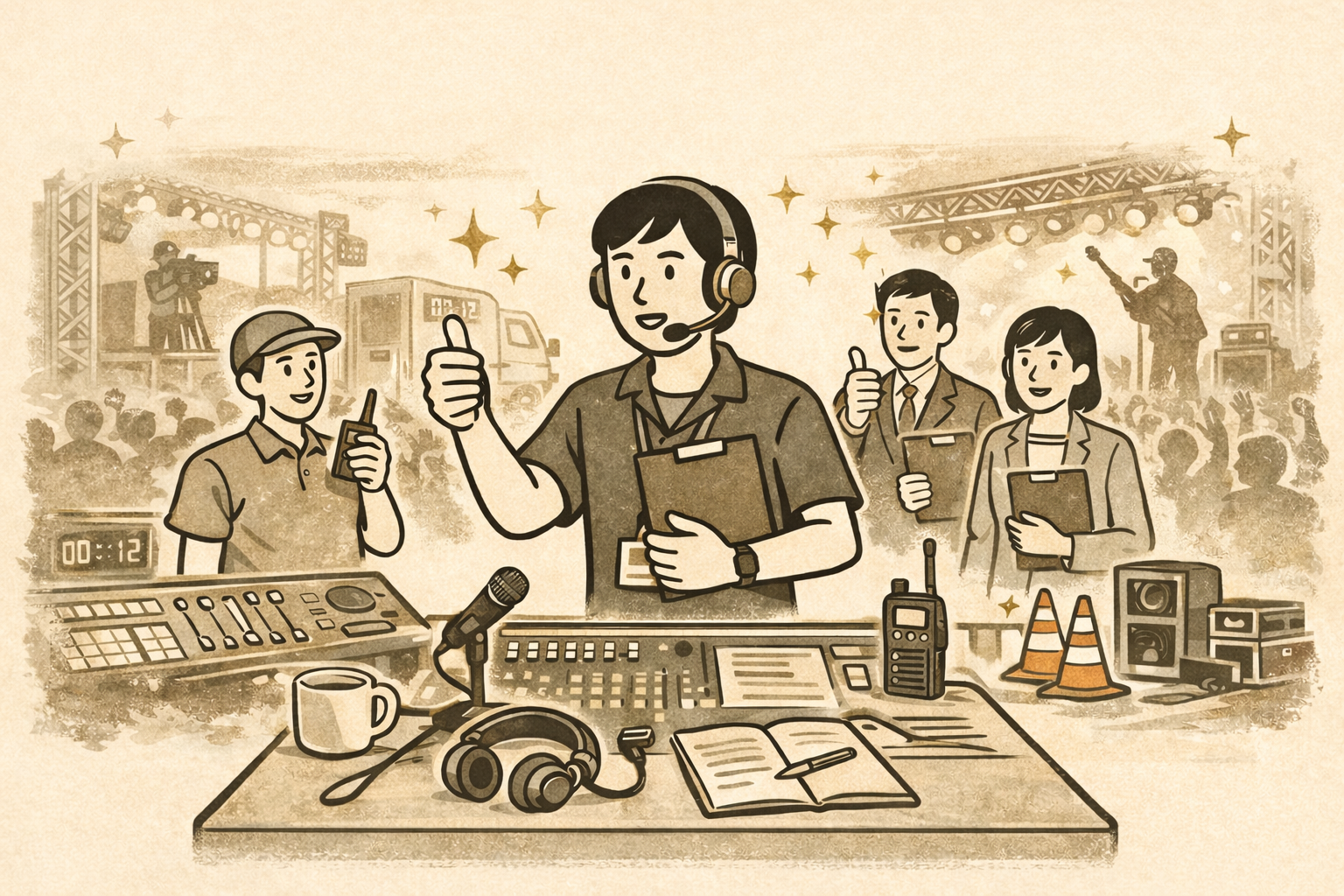
And yet, on every site, there are people others consistently say:
- “I feel safe when this person is here.”
- “When they’re on site, things start to run smoothly.”
These people undeniably exist.
So what do they have in common?
Based on our experience through production management and stage management work,
Tripleguns has identified several key traits shared by people who earn trust on site.
1. The Ability to See the Whole Picture
Reliable team members never focus only on themselves.
They are constantly aware of:
- The stage
- Backstage
- The audience area
- FOH
- Dressing rooms
- Load-in / Load-out areas
They understand how one decision affects the rest of the site.
Rather than optimising only their own task,
they focus on whether the entire site functions as a whole.
This perspective is developed through experience—and it is essential.
The more people who think in terms of “my role, the team, and the overall flow,”
the better the atmosphere on site becomes.
2. The Ability to Make Quick, Decisive Judgements
Things never go exactly as planned on site.
- Rehearsals run late
- Equipment issues occur
- Performer movements change
- Weather or safety concerns arise
Trusted professionals do not chase their own “perfect answer.”
Instead, they decide on the best possible solution at that moment,
and move forward without hesitation.
This decisiveness prevents confusion and keeps the site stable.
3. Clear and Simple Communication
Long explanations rarely work on site.
People’s levels of understanding vary, and time is limited.
Good instructions are:
- Short
- Specific
- Free of ambiguity
For example:
- “Please do this now.”
- “Next action is in five minutes.”
Choosing words that everyone understands in the same way
directly impacts how smoothly the site operates.
4. The Courage Not to Know Everything
This may sound unexpected, but no one on site knows every technical detail.
What matters is:
- Knowing what is outside your expertise
- Trusting specialists in each department
- Understanding only the key points needed for final decisions
Sound, lighting, video, stage mechanics—
a stage manager listens to each professional and makes the final call.
Trying to know everything is not strength.
Knowing where to rely on others is.
5. Emotional Control Under Pressure
A live site is emotionally intense.
- Pressure
- Frustration
- Anger
- Anxiety
Professionals do not bring their emotions onto the site.
By maintaining a calm, consistent tone,
they help everyone around them stay composed.
This is not “endurance.”
It is a skill that protects the entire site.
Even when shouted at, they remain steady—
and never pass that negative energy on to others.
Creating a sense of
“This person is easy to ask”
or
“If I check with them, I’ll be fine”
makes the site run far more smoothly.
6. A Clear Sense of Responsibility
Who is ultimately responsible for the site?
And how would you act in that position?
- If a decision is wrong, you take responsibility
- If a problem occurs, you do not run from it
- You do not blame others
People who carry this mindset naturally earn trust.
Conclusion
What makes a good site professional is not a loud voice or authority.
It is:
- The ability to see the whole picture
- The courage to decide
- Clear communication
- Emotional control
- The willingness to take responsibility
These qualities come together to create someone people genuinely want to work with again.
At Tripleguns, we value these traits
and bring them into every project, both in Japan and internationally.