
Is “It’s Only a One-Day Show” the Most Dangerous Assumption?
Scenario: A Japanese artist has been invited to perform overseas.
The show is only one day.
The set is 30 minutes.
There is no artist fee.
So, can the artist simply enter as a tourist?
Not necessarily.
For international live performances, the correct visa or immigration route depends on more factors than simply whether the artist is being paid.
Authorities may also look at:
- the purpose of the performance
- who invited the artist
- the event type
- the venue
- who pays for travel or accommodation
- whether merchandise is sold
A showcase, festival appearance, PR event and paid solo concert can all require different treatment.
The rules also vary by country.
In the UK, artists may use routes such as Standard Visitor, Permitted Paid Engagement or Creative Worker.
In Singapore, Work Pass Exempt Activities may apply depending on the event and venue.
In Japan, overseas performers may need Entertainer status, commonly referred to as an Entertainer Visa.
Tax is another issue.
Foreign performers may also need to consider:
- withholding tax
- artist tax
- VAT or GST
- customs
- ATA Carnet
- merchandise import rules
So even a one-day live show can involve immigration, tax and customs at the same time.
This guide compares the UK, Singapore and Japan through two common formats:
Showcase / Festival / PR Event
and
Solo Concert / Commercial Show
The goal is simple.
To understand what needs to be checked before the artist gets on the plane.
This article is a general guide based on rules in place as of September 2026. Requirements vary by nationality, event, contract, payment, venue and organiser.
1. Immigration: Being Allowed to Enter Is Not the Same as Being Allowed to Perform
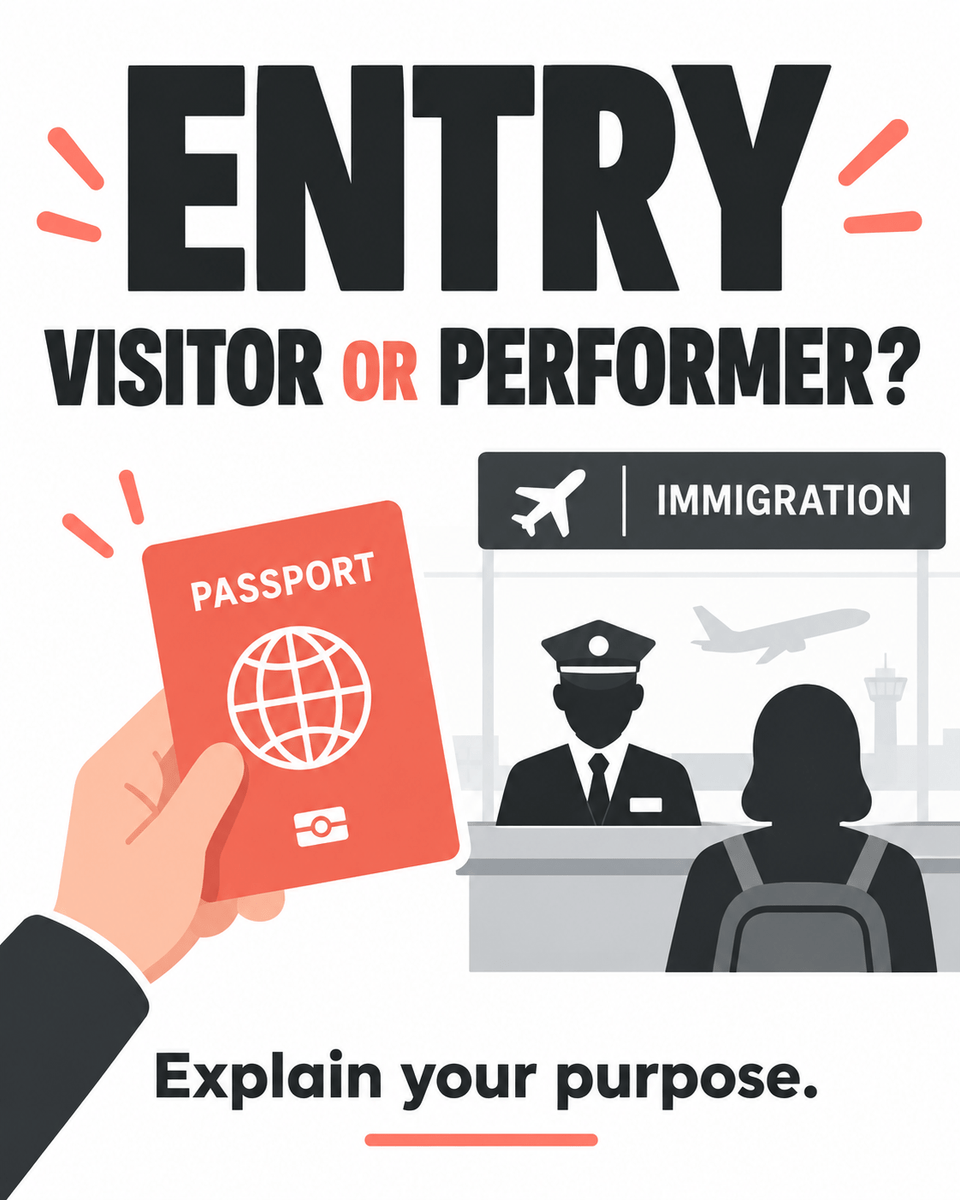
The first question is often:“Do I need a visa?”
A better question is:“Does my immigration status allow this performance?”
Tourists and short-term visitors may usually attend meetings, conferences or business discussions.
Performing on stage is different.
However:Performing does not always mean you need a full work visa.
Some countries have special routes for:
- professional artists
- cultural events
- approved festivals
- promotional activities
- short-term engagements
In the UK, for example, some artist activities are permitted under the Standard Visitor route.
So the answer is not simply:
“Visitor = no performance.”
or
“No visa required = anything is allowed.”
You first need to check whether your specific activity is permitted.
Does “No Artist Fee” Mean There Will Be No Visa Problem?
No.
An unpaid performance can still include commercial or financial elements.
For example:
- flights paid by the organiser
- accommodation
- per diem
- brand promotion
- international marketing
Different countries also look at different factors.
They may consider:
- who invited the artist
- what kind of event it is
- where it takes place
- who pays the artist
So:
“No fee” does not automatically mean “tourism.”
Be Ready to Explain Why You Are Entering
One thing should always be avoided:
Hiding the fact that you are going to perform.
If the event is already being promoted online, your luggage contains stage equipment, and your emails mention an “Artist Fee”, saying only:
“Here for tourism,”
can create problems.
Here’s a simple and useful practical test.
At immigration, can you confidently say:
“I’m here to perform at a festival.”
And can you show:
- an invitation letter
- event information
- your performance agreement
- the promoter’s contact details
- the correct immigration documents
The safest position is to be able to explain your real purpose clearly.
In that sense, you could say that International live production starts at the border, not at soundcheck!
2. Showcase vs Solo Concert
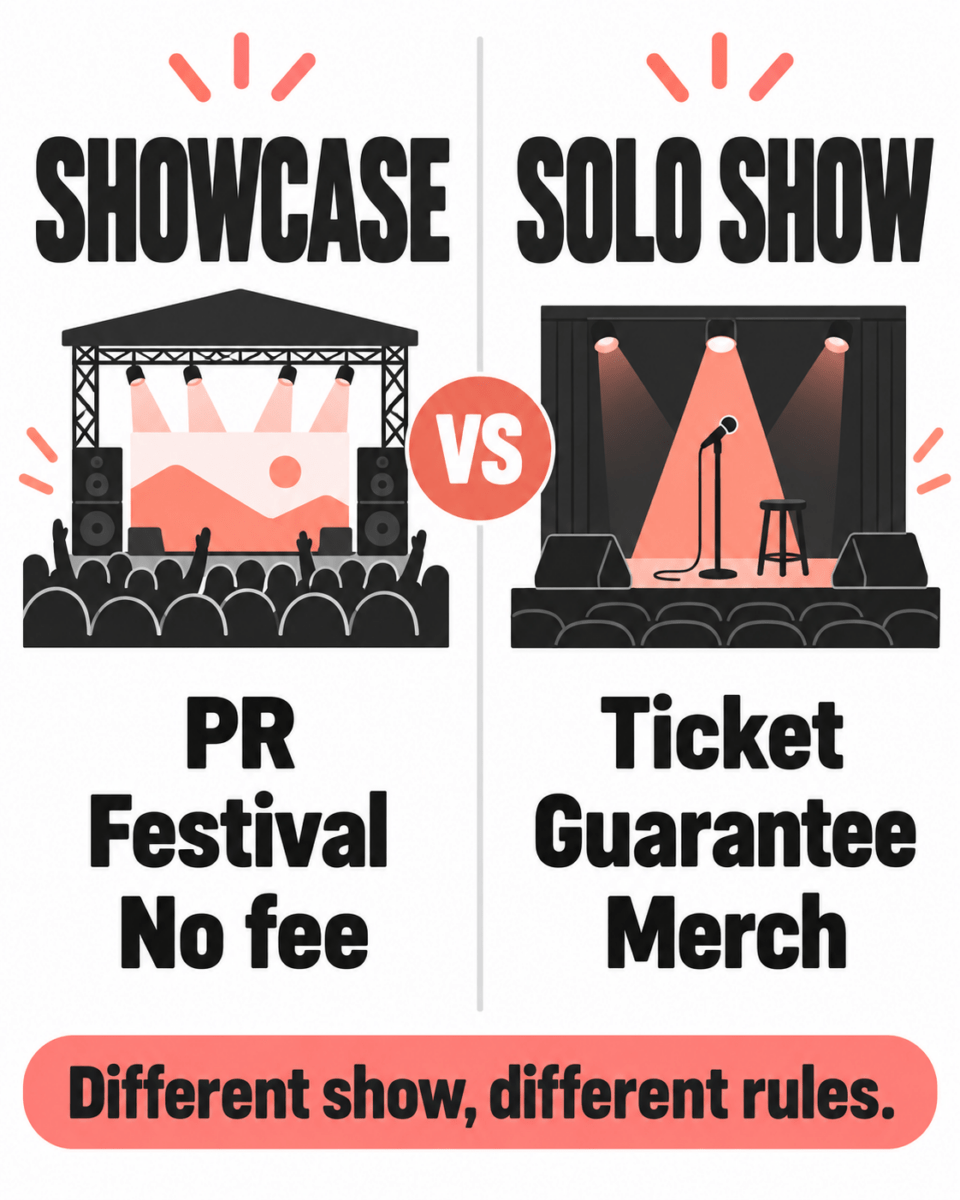
Different types of one-day shows can involve very different requirements.
① Showcase / PR Event / Festival
Examples include:
- industry showcases
- festivals
- cultural events
- government promotions
- label showcases
- brand events
The artist fee may be zero or minimal.
The main purpose is usually promotion rather than direct revenue.
Some countries have special routes for cultural events, approved festivals or short-term professional activities.A full work visa may not always be required.
But you may still need:
- an invitation letter
- event information
- proof of organiser endorsement
Tax
If there is no artist fee, withholding tax may be less of an issue.
However, travel, accommodation and per diem can still have tax implications.
And if you’re selling merchandise, you’ll be creating a separate commercial activity.
② Solo Concert / Commercial Show
Examples include:
- a London headline show
- a Singapore solo concert
- an overseas artist performing in Tokyo
These usually involve:
- ticket sales
- guarantees
- box office splits
- artist fees
- merchandise
The local promoter or inviting party becomes very important.
They may need to coordinate immigration, contracts, tax and venue requirements.
The UK, for example, has several possible routes including:
- Permitted Paid Engagement
- Creative Worker
- Creative Worker Visa Concession
So even a paid show does not always mean one standard work visa.
Tax
If there is an artist fee, withholding tax may come into play.
For example:
Artist Fee: £10,000
You still need to ask:
Is that gross or net?
If this is unclear, the promoter may later face an unexpected tax bill.。
3. Practical Comparison: UK, Singapore and Japan
| Item | UK | Singapore | Japan |
| Showcase / PR / Festival | Some artist activities may be allowed under Standard Visitor | Work Pass Exempt Activities may apply | Check whether the activity falls under Entertainer status |
| Paid Performance | PPE / Creative Worker routes | Check Work Pass Exempt or other work pass routes | Entertainer status is usually the main route |
| Artist Tax | FEU | Non-Resident Public Entertainer, generally 15% | Non-resident withholding tax, generally 20.42% |
| Merchandise | VAT / customs | GST / imports | Consumption tax / imports |
| Equipment | Temporary Admission / ATA Carnet | Temporary Import / ATA Carnet | ATA Carnet |
UK: “Visitor” Does Not Always Mean “Tourist Only”
The UK system is slightly unusual.
Certain artists, entertainers and musicians may perform under the Standard Visitor route.
Professional artists may also qualify for:
Permitted Paid Engagement
or, in some cases:
Creative Worker Visa Concession
So for a UK show, the practical question is often:
“Standard Visitor, PPE or Creative Worker?”
rather than simply:
“Do I need a visa?”
Singapore: The Event and Venue Matter
Singapore has:
Work Pass Exempt Activities
Some foreign performers may qualify depending on the event and venue.
This means different treatment for different 30-minute performances.
The older Work Permit for Performing Artiste route is no longer open for new applications.
International rules may change.
Never assume last year’s route still applies.
Japan: Inviting Overseas Artists
For overseas singers, musicians and dancers performing in Japan, the main immigration status is usually:
Entertainer
The application may involve information about:
- the inviting organisation
- the contract
- the venue
- the performance period
- the artist fee
Again:
No artist fee does not automatically mean a short-term visitor status is acceptable.
4. Merchandise: Another Common Trap
Merchandise is often forgotten.
You bring 50 T-shirts into another country.
You sell them at the venue.
From a customs perspective, this is:
the import and sale of goods.
It is not simply personal luggage.
ATA Carnet Is Not for Selling Merchandise
ATA Carnet is useful for temporarily importing items such as:
- instruments
- PA equipment
- camera equipment
- professional equipment
The key expectation is:
The same item is imported and will be exported again.
For example:
Guitar
Bring in → Use → Take home
But:
T-shirt
Bring in → Sell → Product stays in the country
These are different customs processes.
Merchandise Also Creates Tax Issues
Selling locally may also involve:
- import duty
- VAT or GST
- venue commission
- card fees
- sales settlement
For example:
100 T-shirts × £30 = £3,000
That does not mean the artist keeps £3,000.
Freight, tax, commission and payment fees all eat into the final profit.
Merchandise should therefore always be planned before the tour.
5. International Live Shows Cross Three Borders

PERSON 人
Who is travelling?
What immigration status do they need?
This may include the artist, tour manager, engineers, technicians and production staff.。
MONEY お金
- Artist Fee
- Guarantee
- Box Office
- Travel Buyout
- Per Diem
- Accommodation
- Merch Revenue
Who pays whom? And where does tax apply?
GOODS モノ
- Instruments
- Backline
- Wireless Equipment
- Merchandise
- Props
What crosses the border? Which items are temporarily imported?
Make plans for all three: PERSON / MONEY / GOOD before the tour starts.
Comparing Four One-Day Shows
CASE A | London Industry Showcase
・20-minute set
・no artist fee
・flights paid by the Japanese side
・promotional purpose
Check:
→ Standard Visitor eligibility
→ invitation letter and event information
→ customs if merchandise will be sold
No artist fee does not automatically mean tourism.
CASE B | London Solo Concert
- £30 ticket
- 500 capacity
- UK promoter
- artist guarantee
Check:
→ PPE or Creative Worker
→ UK inviting party and contract
→ FEU tax requirements
→ merchandise, VAT and customs
Even a one-day show may involve immigration, tax, contracts and merchandise.
CASE C | Singapore Cultural Event
・30-minute performance
・cultural promotion
・artist fee paid
・formal invitation
Check:
→ Work Pass Exempt eligibility
→ event and venue conditions
→ Non-Resident Public Entertainer tax
→ withholding tax
In Singapore, where and at what event you perform matters.。
CASE D | Overseas Artist in Tokyo
- Japanese promoter
- ticket sales
- artist fee
- equipment and merchandise imported
Check:
→ Entertainer status
→ promoter and venue documents
→ withholding tax
→ ATA Carnet for equipment
→ merchandise import procedures
Having the right visa is only one part of coming to Japan to perform.
Tax, equipment and merchandise also need to be planned in advance.
▶What These Examples Show
The number of performance days is not always the most important factor.
More important questions are:
・Where are you performing?
・Who invited you?
・Why are you performing?
・What does the contract say?
Even for one day shows, remember:
PERSON | Immigration
MONEY | Fees and tax
GOODS | Equipment and merchandise
Conclusion: Is It Easier to Perform Overseas Without an Artist Fee?
Sometimes.
But “no artist fee” does not automatically mean “no visa problem.”
An unpaid showcase may qualify for a simpler immigration route than a commercial concert.
But artist payment is only one factor.
For a one-day international live performance, always check:
1. PERSON
Who is travelling, and what immigration status allows them to perform?
2. MONEY
Who is paying the artist, and what withholding tax or local tax may apply?
3. GOODS
What equipment and merchandise are crossing the border?
The answers are likely to differ by country.
In the UK, the key issue may be whether the artist qualifies under Standard Visitor, PPE or Creative Worker rules.
In Singapore, the event type and venue can affect whether Work Pass Exempt Activities apply.
In Japan, the key question is often whether the activity falls under Entertainer status.
The same principle applies to merchandise.
Bringing a guitar into another country for temporary use is not the same as importing 100 T-shirts to sell at a venue.
Immigration, artist tax and customs should therefore be planned together.
A useful final check is simply:
Can the artist tell immigration:
“I’m here to perform,”
and confidently show the correct documents?
If yes, the project is starting from the right place.
If not, the immigration route should be reviewed before travel.
Quick FAQ
1.Can a musician perform overseas on a tourist visa?
Sometimes a tourist visa allows certain artist activities.
But this depends on the country, event and payment structure.
Never assume that no artist fee automatically means tourism.
2.Does a one-day performance require a work visa?
Not always.
Some countries have short-term artist routes, visitor exceptions or work pass exemptions.
The exact route depends on the performance.
3.Can an unpaid overseas showcase still create tax or customs issues?
It can.
Travel expenses, accommodation, merchandise sales and temporary equipment imports may still create tax or customs requirements.

Planning an Overseas Live Show?
Tripleguns supports international live production from Tokyo, Singapore and London.
We work with Japanese artists, management teams and promoters on:
- overseas concerts
- world tours
- festival appearances
- showcases
- international live events
Our production work includes:
- local promoter and venue coordination
- production advance
- technical advance
- local crew and equipment
- immigration requirement checks
- artist fee and withholding tax coordination
- ATA Carnet and equipment logistics
- merchandise and customs planning
Where specialist immigration, legal or tax advice is required, we coordinate with local professionals.
If you have received an overseas festival offer, are planning a first international concert, or are inviting an overseas artist to Japan, you can feel free to contact us right from the early planning stages!