
South Korea and France are committing a combined €1 billion over five years to the film and audiovisual industries.
In the UK, major investment into the creative industries is moving forward, while London’s live entertainment market has recorded one of its biggest summers ever.
And in Japan, a new programme called IP360 has been launched alongside discussions suggesting that more than ¥500 billion in public support over five years may be needed to accelerate the growth of the content industry.
Film, music, animation, games and live entertainment.
For many years, these sectors were often discussed in the context of “supporting culture”.
But around the world, that language is beginning to change.
Creative industries are increasingly being treated as growth industries, export industries and areas for strategic investment.
Looking at some of the major developments between January and September 2026, we explore what is changing from the perspective of a company working in international live production and events.
South Korea and France | €1 Billion Over Five Years
On 7 September 2026, South Korean President Lee Jae-myung and French President Emmanuel Macron announced the Lumière Partnership.
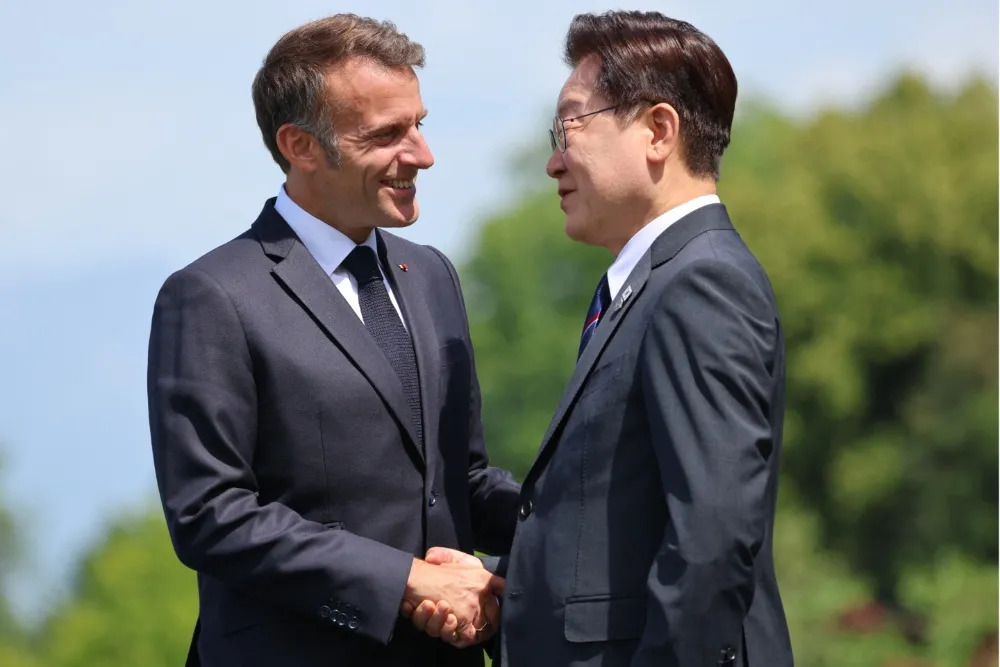
Getty Images
Between 2027 and 2031, the two countries plan to mobilise:
€500 million from South Korea
€500 million from France
for a combined total of €1 billion.
The investment will target film, television, animation and other audiovisual sectors.
More than simply a grant programme for individual productions, the partnership is expected to cover areas including corporate investment, R&D, loans and guarantees, international expansion and cross-border co-production.
On the French side alone, Bpifrance is expected to mobilise €500 million over the five-year period.
South Korea is also increasing its own domestic content investment.
In January 2026, the country announced a KRW 730 billion content policy fund, around 22% larger than the previous year and the biggest of its kind to date.
The fund supports not only film, but also performing arts, games, webtoons, audiovisual production and international expansion.
What is particularly interesting is the shift in thinking.
From:
“Support good creative work.”
To:
“Invest in content companies, help them grow, and enable them to earn internationally.”
The global success of K-Culture was never driven by creative talent alone.
Behind it sits an increasingly sophisticated system of financing, production, distribution and overseas expansion.
And that system is now moving into its next stage.
The UK | Large-scale Live Entertainment Is Booming, But the Picture Is More Complicated
The UK also clearly identifies the creative industries as a major growth sector.

https://www.gov.uk/government/news/government-launches-bold-plan-to-turn-up-the-music-industry
In 2026, UK Research and Innovation launched a strategy to invest £369 million between 2026 and 2030 in the creative industries.
The investment covers not only research and development, but also creative technology, IP, business growth, skills and regional clusters.
There are also new developments in music.
In July, the UK government announced Turn It Up: Our Plan for Music, expanding the Music Growth Package to £45 million over three years.
The package is expected to support more than 2,000 projects and over 40,000 artists and music professionals, including international expansion.
At the same time, London’s large-scale live entertainment market is extremely strong.
In 2025, 9.1 million people travelled to London for music-related reasons and spent around £3.4 billion, an increase of more than 27% year on year.
Summer 2026 has also been huge for the market.
Wembley Stadium hosted a record 34 concerts, attracting more than 2.5 million people.
Harry Styles alone performed 12 shows there, while The O2 also recorded its strongest August to date.
But look beneath the headline numbers, and the picture changes.
According to Music Venue Trust, 53% of UK grassroots music venues failed to make a profit in 2025, while 30 venues closed permanently.Around 6,000 jobs were also lost.
Then in September 2026, Gate Theatre, founded in Notting Hill in 1979, announced that it would close in October after almost 50 years of activity.
https://www.timeout.com/london/news/one-of-londons-most-beloved-off-west-end-theatres-closed-090926
The decision followed the loss of Arts Council England funding, rising production costs and increasingly intense competition for limited resources.
The UK is therefore facing a striking contrast:
stadiums are breaking records, while grassroots venues are struggling to survive.
Growth at the top of the market does not automatically flow down to smaller venues, theatres or emerging artists.That is an important point to consider when thinking about the future of cultural policy.
Europe | Protecting Culture as a Source of Competitiveness
The EU’s Creative Europe programme has a budget of around €380 million for 2026.
It supports film, audiovisual production, music, performing arts, publishing and other cultural sectors.
But its objectives go beyond cultural diversity.
The programme also explicitly focuses on strengthening the competitiveness of Europe’s creative industries.
Germany is taking an especially bold approach.
In 2026, the federal government expanded economic support for film production to €250 million per year.
It also introduced plans requiring streaming services and broadcasters to reinvest at least 8% of certain annual revenues in Germany into domestic film and audiovisual production.
The idea is simple:
If you generate revenue through Germany’s content market, you should also contribute to Germany’s production ecosystem.
In an era dominated by global platforms such as Netflix, this reflects a broader European debate around how to protect and develop domestic producers, creators and IPs.
It is also a clear example of what might be called cultural sovereignty.
The United States | Bringing Production Back
In the United States, state-level production incentives remain especially important.
California is a major example.
The state expanded its Film & Television Tax Credit programme from $330 million to $750 million per year.
During the first year following the expansion, 170 productions were approved.
https://abc7.com/post/bass-raman-praise-newsoms-signing-bill-expands-film-tv-tax-credits/19852566
California estimates that these projects will generate around $6.6 billion in direct production spending and create approximately 35,000 cast and crew jobs in the state.
This is less about “supporting culture” in the traditional sense.
It is an economic policy designed to bring production activity into a region.
When a film or television production arrives, spending does not stop at the studio.
It also reaches technicians, hotels, transport companies, catering, equipment suppliers and many other local businesses.
In this model, content production is treated as part of a wider industrial infrastructure.
🌏 Asia | Investing in Talent, Production and Global Markets
Across Asia, countries are taking very different approaches.
▶India’s 2026 budget places greater emphasis on what it calls the Orange Economy, including animation, VFX, gaming, comics and XR.The government plans to invest INR 250 crore to establish Content Creator Labs across 15,000 secondary schools and 500 universities and colleges.
This is not simply an investment in existing content.It is an investment in the next generation of creators themselves.
▶Singapore has also expanded its arts support.
From April 2026, the National Arts Council restructured its funding programmes, raising annual grant limits to as much as S$100,000 for activities such as music recording, performances, exhibitions, festivals and conferences.
▶Saudi Arabia is moving even closer to a financial investment model.
By the first quarter of 2026, the Cultural Development Fund had provided more than SAR 770 million in financing to 165 cultural projects.
Those projects have in turn attracted approximately SAR 1.1 billion in private-sector investments.
The approaches differ from country to country.
But one theme appears again and again:
Culture × Business × Technology × Global Market are increasingly being considered together.
Japan | IP360 Has Begun
Japan is also beginning to change.
The FY2025 supplementary budget included ¥55.631 billion in content-related funding.
https://note.com/milaresoiida/n/ne696bd779e98?hl=en
At the centre of this is the Ministry of Economy, Trade and Industry’s ¥35.02 billion Content Industry Growth Investment Support Programme.
One of its new initiatives is IP360.
The programme supports Japanese content across a broad range of areas, with the goal of increasing overseas sales to ¥20 trillion by 2033.
Its scope includes:
- new IP creation
- large-scale production
- international expansion
- localisation
- overseas promotion
- global distribution
- production and development infrastructure
In other words, the programme covers the full journey from creating IP to taking it into international markets.
Demand has already been overwhelmingly strong.
In some areas, including music, applications for the first round exceeded available funding to such an extent that a second round was not held.
Then in June 2026, the government published materials going even further.
The content industry is now being discussed under the targets of:
“tripling overseas sales and tripling investments.”
The goal remains ¥20 trillion in overseas content sales by 2033.
The same government materials also note calls from industry for more than ¥500 billion in public support over five years to achieve that level of growth.
This does not mean the Japanese government has formally committed to spending ¥500 billion.
But the fact that investment at this scale is now part of the policy debate is itself significant.
Japan Is Also Starting to Measure Music as an Export Industry
One development we found particularly interesting is music.
In 2026, METI published detailed data on the overseas performance of Japan’s music industry.
Overseas sales in 2024 were estimated at ¥123.95 billion.
When spending by international visitors on music products and domestic live performances is included, the figure rises to ¥151.67 billion.
At first glance, this may look like just another set of statistics.
But policy cannot be built effectively without first understanding how much an industry is actually earning overseas.
Japan’s music policy may therefore be moving
from:“introducing Japanese music overseas”
to:“measuring how much the music industry can grow in international markets.”
That is an important shift.
From Cultural “Cost” to Cultural Investment
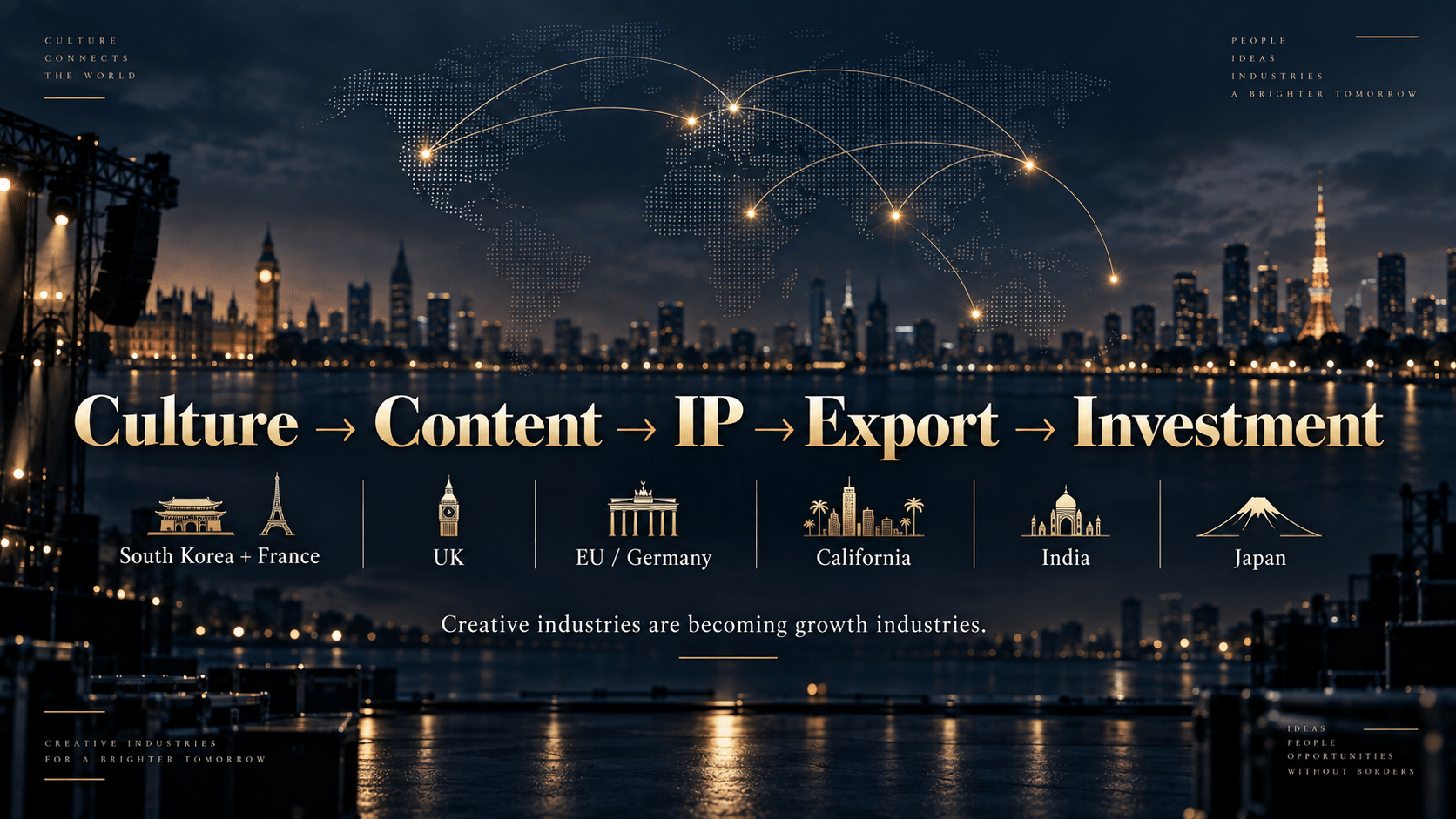
Looking across the world in 2026, one larger pattern is becoming clear.
South Korea is developing K-Content as an export industry.
France is combining cultural sovereignty with corporate investment.
The UK is treating the creative industries as a national growth sector.
Germany is asking global platforms to reinvest into domestic production.
California is using incentives to bring film and television production back into the state.
India is investing in the next generation of creators.
And Japan has launched IP360.
Around the world, a clearer line is emerging:
Culture → Content → IP → Export → Investment
But the UK example also offers an important warning.
The success of major IPs, blockbuster productions and stadium concerts does not automatically guarantee the survival of smaller theatres, grassroots venues or emerging artists.
If the content industry is to grow sustainably, investments cannot stop at individual productions.
It also needs to support the wider ecosystem that includes:
creators, production companies, venues, technicians, distribution, and the people who actually bring content into international markets.
And as Japanese content expands overseas, the work that happens after the content has been created will become increasingly important.
Choosing venues for overseas concerts.
Coordinating with local promoters.
Technical production.
Local staffing.
Logistics.
Permits and regulations.
Exhibitions and event operations.
There is still a huge amount of production work between creating great IPs and actually delivering them successfully to an international audience.

Tripleguns supports Japanese artists and companies with international expansion across the UK, Europe and Asia, including overseas concerts, festivals, exhibitions, corporate events and on-site production.
2026 is beginning to look like a turning point in the way Japanese content connects with the world.
From the production side, we will continue watching closely as that landscape evolves.
This article is based on announcements and information published by governments, public institutions and industry organisations as of 10 September 2026.