
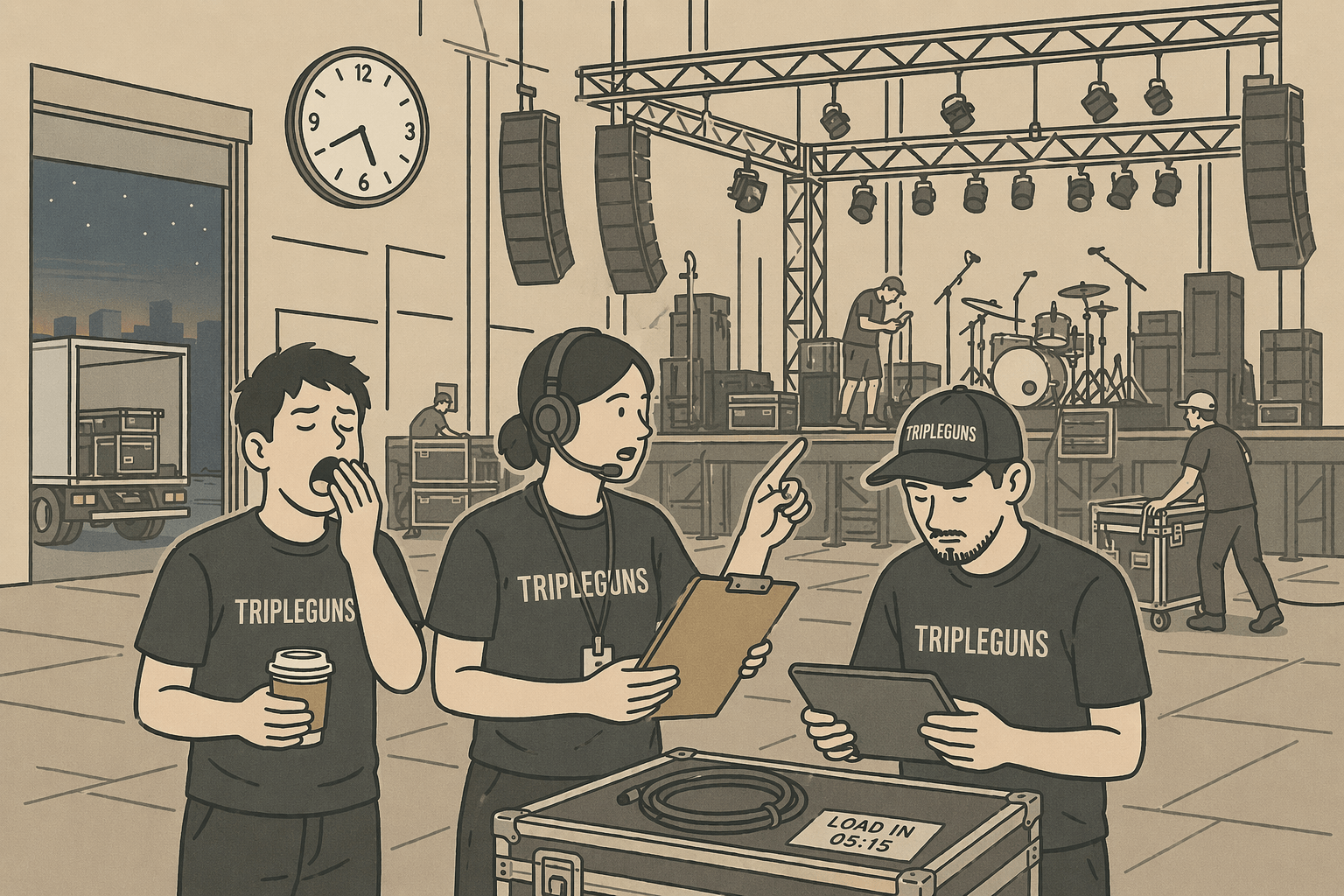
When people hear the word live show, they often imagine the moment the doors open, the excitement in the crowd, the lights going down, and the artist stepping onto the stage.
But in reality, a live show begins many hours earlier — and depending on the venue, sometimes even days before.
By the time the audience arrives, countless tasks have already been underway behind the scenes, with a large number of staff busily laying the groundwork for the upcoming show.
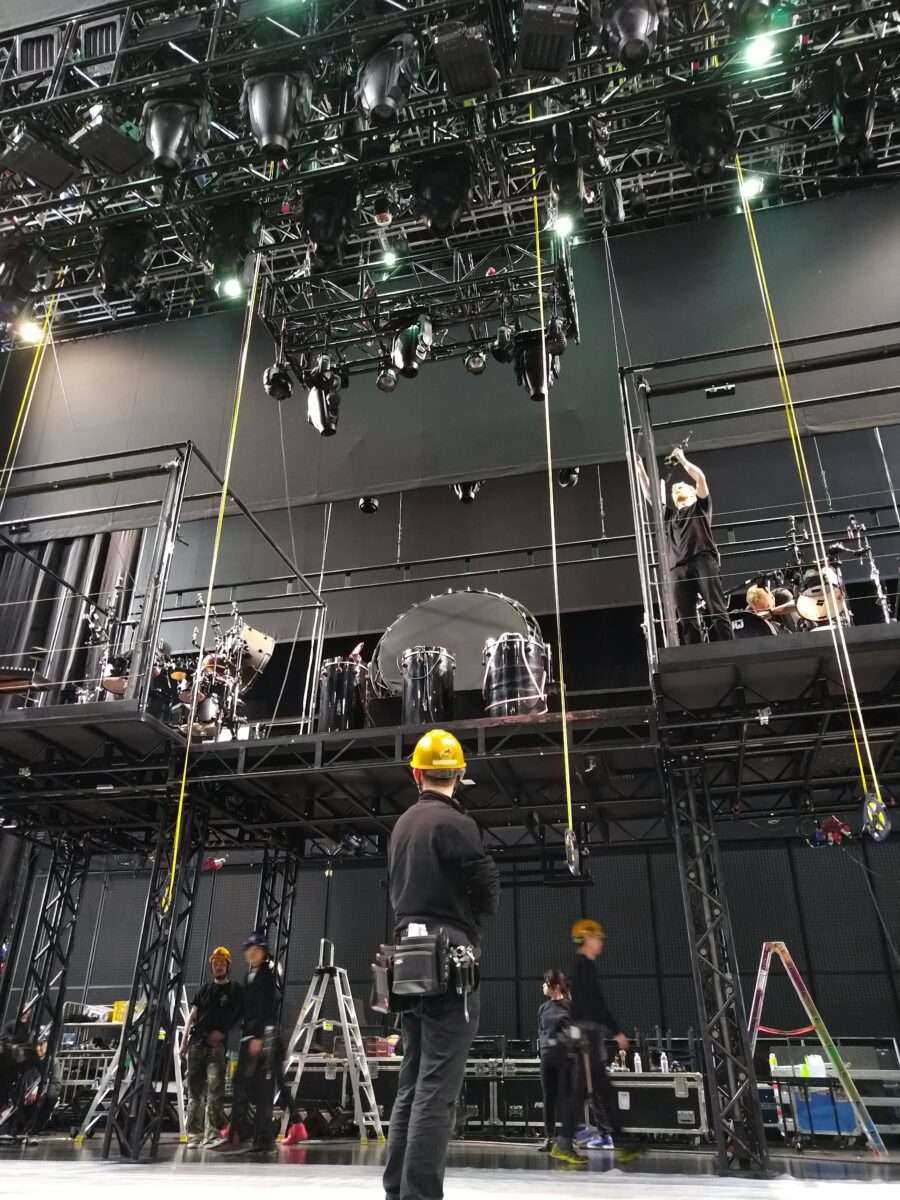
Tripleguns is an international live production company connecting Japan and the world. We support Japanese artists’ overseas concerts and world tours, including local production management, venue coordination, and stage production support.
Behind every glamorous performance, there are professional crews preparing, adjusting, and problem-solving every step of the way.
In this article, we’ll take a closer look at how and when live production really begins in a way that even those unfamiliar with the live entertainment industry can understand and appreciate.
A Concert Doesn’t Start at Show Time
For most people, the start of a live show might look something like this: Doors open at 6:00 p.m., show starts at 7:00 p.m.
But the production team operates on a completely different timeline.
For large capacity arena or dome performances, almost all preparation work has to start way before the day of the show depending on the size of the production. The schedule for a show taking place in a large venue, for example, usually looks something like this:
- Day 1–2: Venue protection, stage construction, and audio, video, and lighting setup
- Day 3: Stage marking and technical rehearsals
- After that: Production meetings and detailed confirmation of staff positions
- Show day: Performance, followed immediately by load-out after the show
In other words, a live show is not something that suddenly begins on performance day itself. It follows an extremely densely packed schedule of carefully timed processes that enable the building of a massive temporary environment which must then be returned to its original state within a limited timeframe.
Several days of preparation are stacked behind just a few hours of performance. That is why mornings on site usually start early.
Early Morning at the Venue: Quietly in Motion
There is a unique vibe at a production venue in the morning.
Some people still look half asleep.
Many of the team members may be meeting for the first time.
Not everyone is cheerfully chatting.
In fact, it is often quiet and subdued.
But amidst that quietness, work has already begun.
Who is leading the day?
Which staff are assigned to which sections?
How tight is today’s schedule?
Where does the work begin?
The morning briefing often sets the tone for the entire day. Experienced crew members can usually tell within the first few minutes whether it is going to be a long day.
Working in live production is therefore not simply a matter of waking up early.
Because so many people need to move at the same time within a limited schedule, the initial setup and coordination are absolutely critical to success.
The First Step: Protecting the Venue Before Setup
When people think of live production, they often picture the stage, lighting, or giant screens.
For all of that to be put in place, something more important has to come first.
Venue protection.
In large venues, floors, walls, loading areas, and dressing room routes must be carefully protected before construction begins.
This is because the equipment is heavy, and there is usually a lot of it, and there will be may heavy-duty carts moving constantly back and forth. Even the slightest mistake can cause serious damage to the venue.
That is why proper protection is one of the very first steps to be carried out.
It is not something the audience ever sees, but it is essential all the same. Without this quiet preparation, the larger-scale setup that follows cannot be done safely.
Behind each live production is a series of rigorous and invisible tasks that are often unglamorous yet critical to a show’s ultimate success.
Stage, Audio, Lighting: Everything Moves at Once
Once the venue is ready, every department begins moving at the same time.
The construction crew builds the stage.
The audio crew prepares speakers, consoles, and signal lines.
The video crew sets up LED screens, playback systems, and visual outputs.
The lighting crew rigs fixtures, focuses them, and checks circuits.
Each department may appear to be working separately, but everything is actually connected.
If stage construction is delayed, the lighting and video teams are affected.
If audio setup takes longer than expected, rehearsal times may shift.
One delay can have a domino effect on everything that follows, and the time available for setup is always limited.
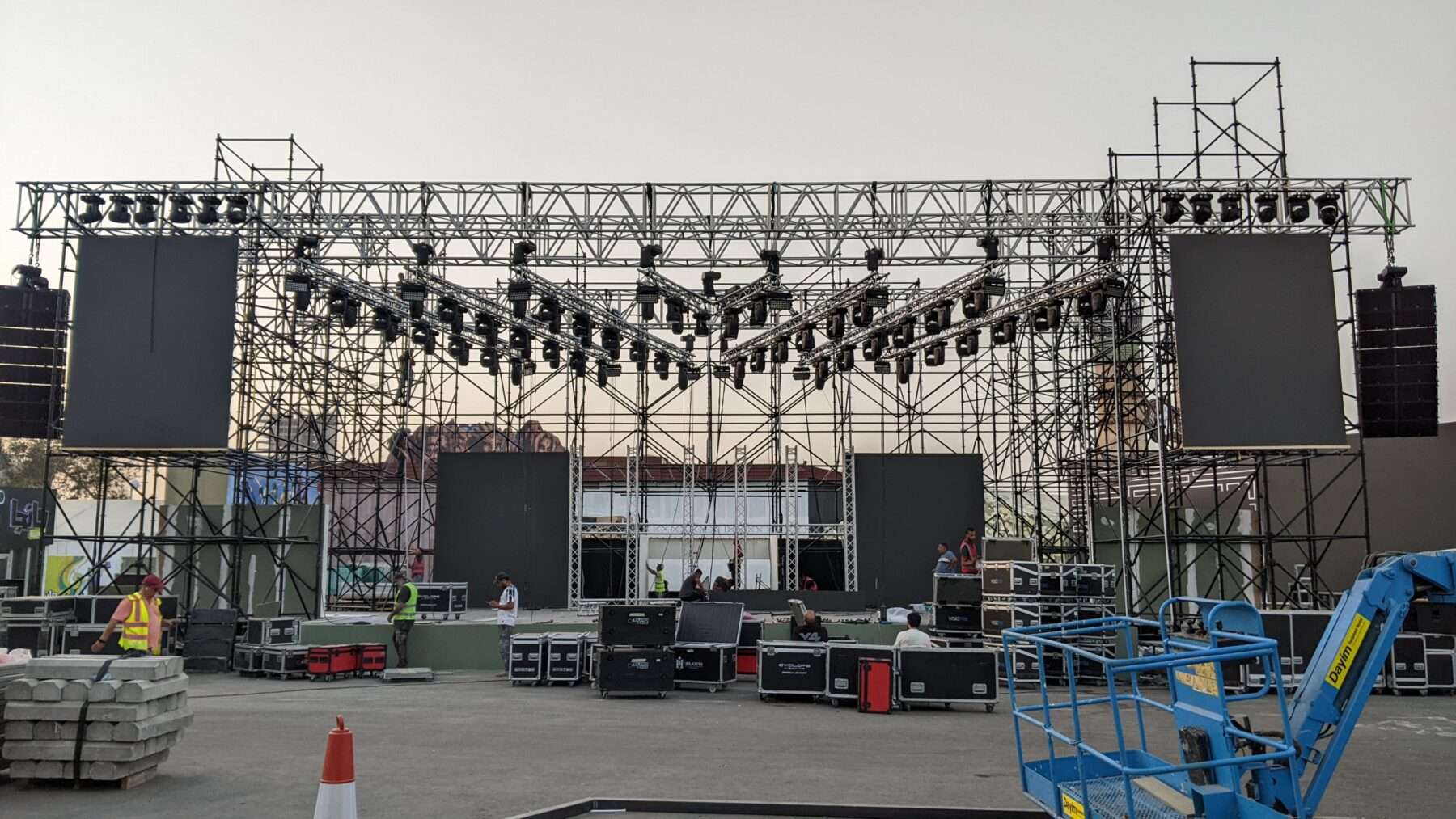
Venues have strict access hours, and show times usually cannot be moved, so live production teams are always expected to build the stage in the shortest time possible.
Coordinating all the moving parts of a production to ensure that the stage is set up in a timely, accurate, and safe manner is one of the hardest parts of live production.
Problems Will Happen Before Rehearsal
Experienced production crew understand and expect one thing.
Problems will usually crop up before rehearsal😿
It could be anything. A technical issue. A problem with signal lines. A piece of equipment that does not fit where it was supposed to. A missed detail that only becomes visible on site.
On overseas shows, language differences and venue rules can add even more complexity.
Of course, that does not mean there will always be major problems but small adjustments and unexpected issues are almost always part of the day.
That is why backstage staff must be versatile professionals who can assess problems quickly, adjust on the fly, and ensure issues do not affect the next stage of the process.
The most experienced crew members may seem calm and quiet, but they are often thinking several steps ahead.
This is where experience really matters.
Early Mornings, Late Nights — So Why Do People Keep Coming Back?
As you can see, live production is not an easy job.
Work starts early, and if setup runs late, can continue well into the night. Load-out begins immediately after the show ends. The job is both physically demanding and mentally draining.
And yet, people stay in this industry. They come back to the venue again and again.
One reason, of course, is a genuine love of music.
Even though the staff are not the ones standing on stage. or receiving applause, what sustains them through those difficult days is the sincere desire to help artists deliver the best performance possible and see audiences leaving the show feeling glad they came.
The staff working behind the scenes are not working only for themselves. They are working for the artist, for the audience, for the organiser, and for the success of the entire show.
Because it is work done for everyone, they are able to keep going even when the going gets tough.
Behind the scenes, there is a level of professionalism and love for music that is not always visible from the outside.
How Tripleguns Supports Global Live Productions
Tripleguns supports the on-site success of overseas concerts, world tours, corporate events, and exhibitions for Japanese artists and companies.
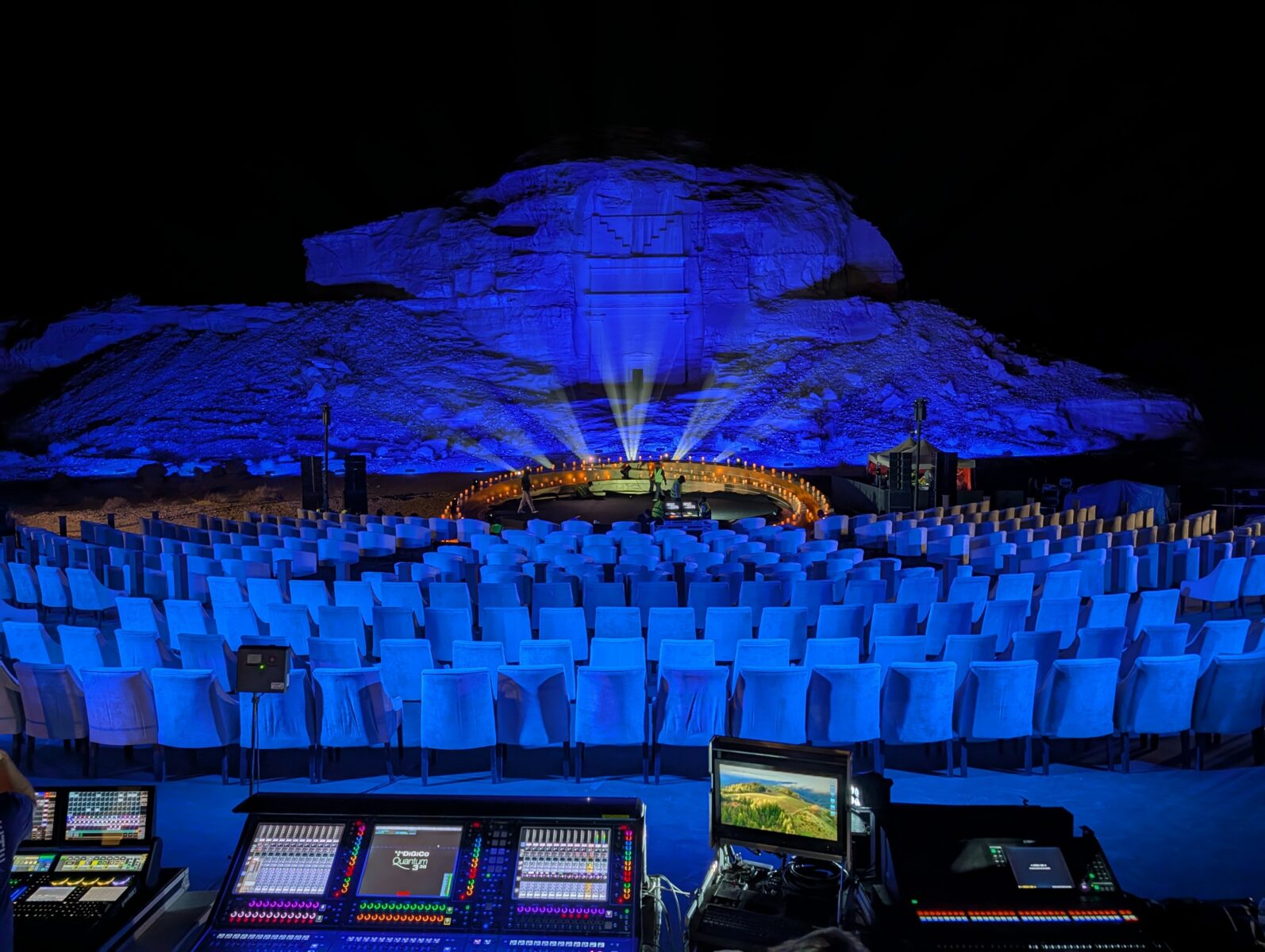
Our role is to handle the invisible but essential parts of a successful show: venue coordination, communication with technical teams, production management, scheduling, and bridging gaps between Japanese clients and local crews.
Leading up toevery performance is a series of necessary events that can be difficult to juggle – from early morning preparation work, to long business trips, unfamiliar local meals, the constant need to manage one’s condition while working under pressure, the challenge of building a stage within a limited timeframe, the professional judgement required at every step to solve problems and keep the show moving towards opening time, and above all, the work of a great many people coming together to deliver music to an audience, just to name a few.
A live show does not begin when the performance starts. It has usually already begun many hours earlier — sometimes many days earlier — through the work of countless professionals behind-the-scenes.
Definitely not just at 6 a.m. on the day itself, and you know that now!
More Tripleguns blogs here: