
The Essential Crew Roles Behind an Overseas Tour
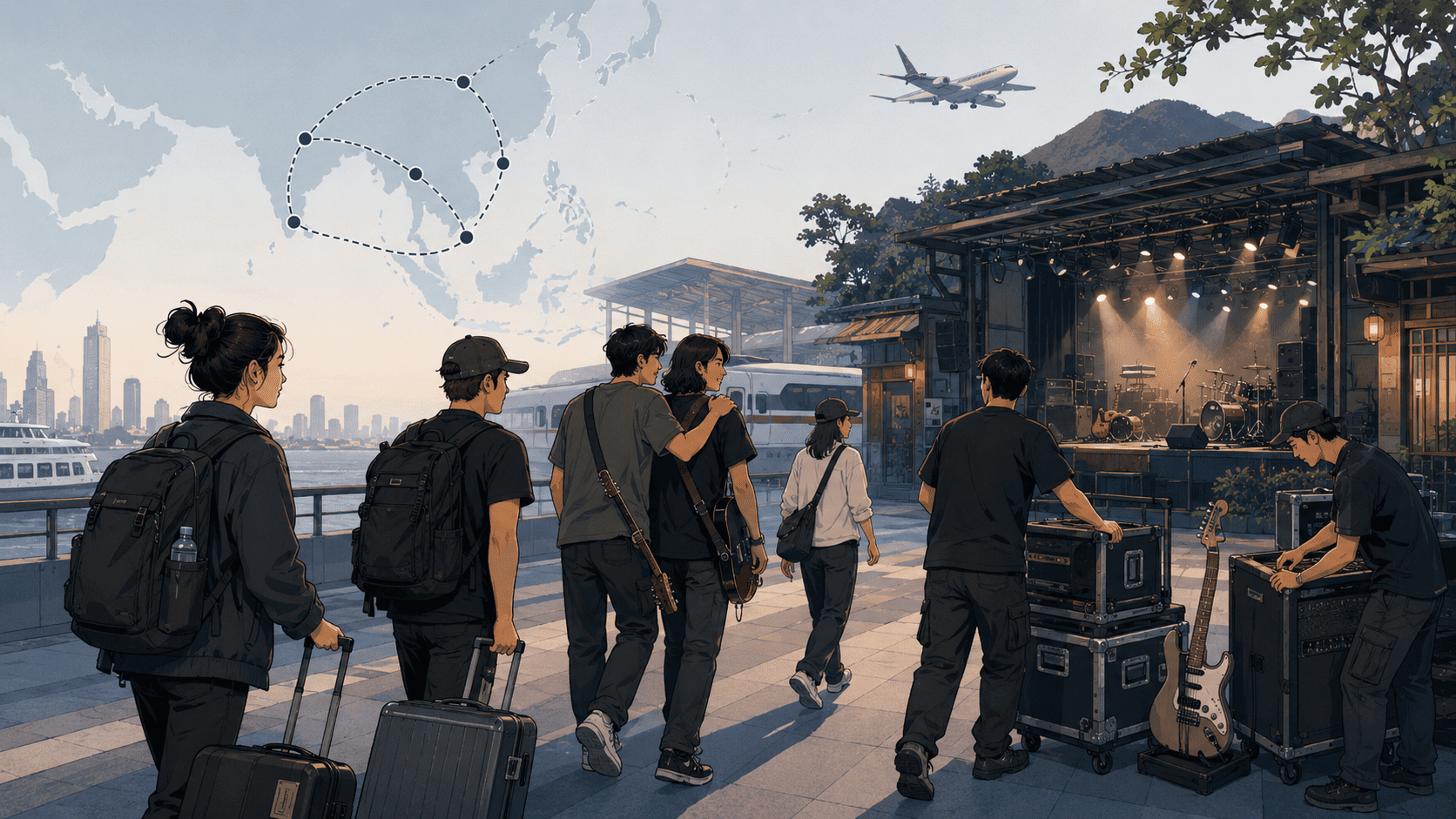
When people think of an overseas concert tour, the first image that usually comes to mind is the artists on stage.
A vocalist under the spotlight.
Band members playing live.
The excitement of the audience.
The energy of the venue.
Of course, the artists are usually at the centre of the show.
But an overseas tour does not run on artists alone.
Before any artist can step onto the stage, many things have to happen first. The artist needs to arrive safely in the country. The equipment needs to reach the venue. Rehearsals need to take place. The show needs to run on time. Merchandise needs to be sold. The stage needs to be cleared after the performance. Then everyone has to move on to the next city.
Behind that entire process, there are many different crew members working together.
This is especially true for overseas tours, where language, time zones, travel distances, venue facilities, visas, customs, local crew systems and communication with local partners can all become part of the production challenge.
In this article, Tripleguns, an international live production company connecting Japan and the world, will introduce some of the key crew roles that support an overseas tour.
Some of these include artist managers, tour managers, production managers, technical crew, merchandise managers, hair and make-up artists, stylists, photographers, videographers, interpreters, local coordinators, local runners and more.
An overseas tour is a moving production site
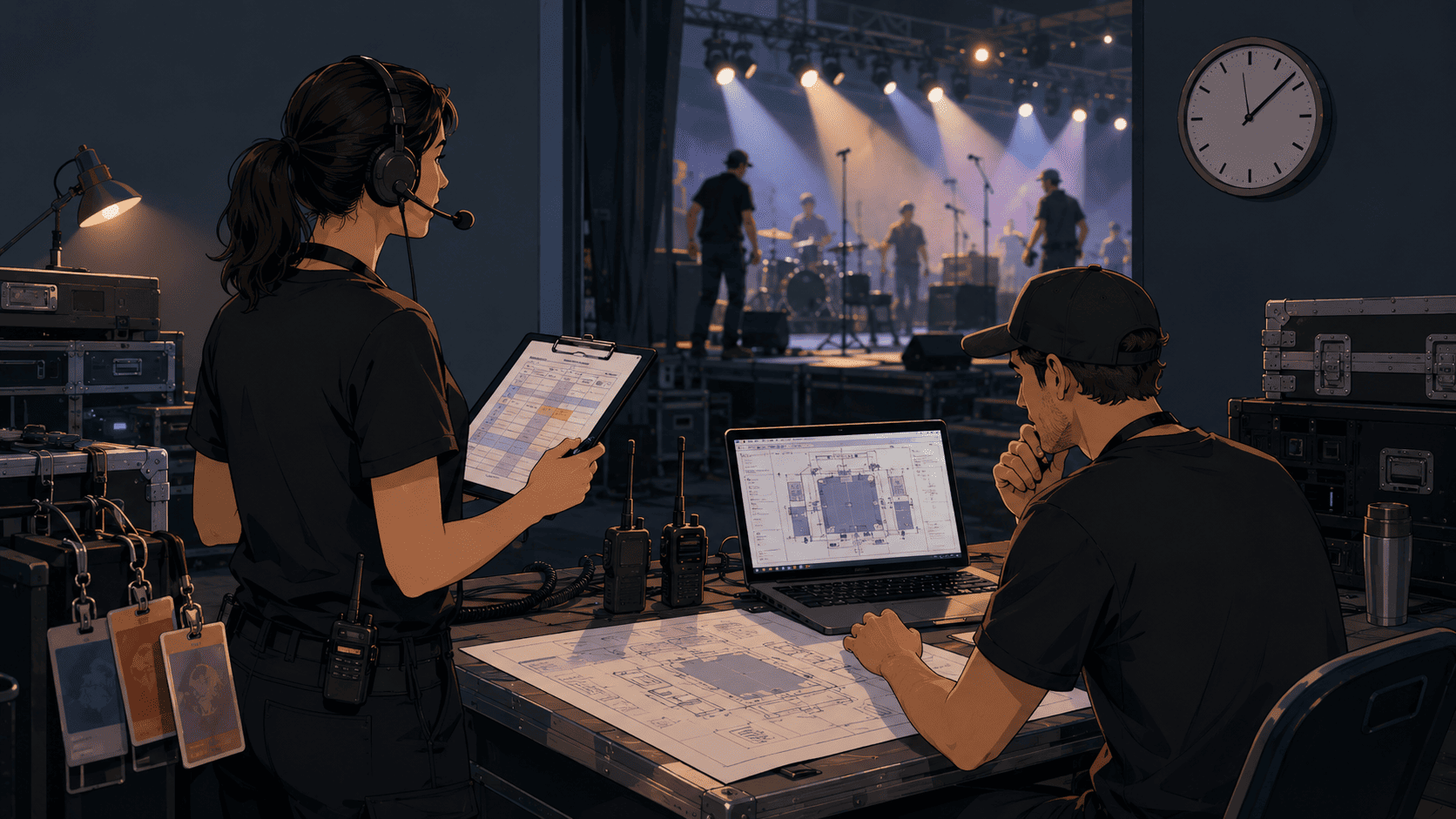
A live show does not begin only when the artist arrives at the venue.
For an overseas tour, preparation begins long before show day. Flights, hotels, vehicles, equipment transport, communication with local promoters, venue checks, technical coordination, merchandise sales and local staffing all need to be organised in advance.
On show day, the schedule can include load-in, stage setup, audio, lighting and video checks, instrument setup, rehearsals, doors, show time, post-show merchandise sales, load-out and preparation for the next city.
In other words, an overseas tour is not just a series of individual concerts.
It is a moving production site.
To keep that moving site running, many different crew roles are needed.
Artist Manager
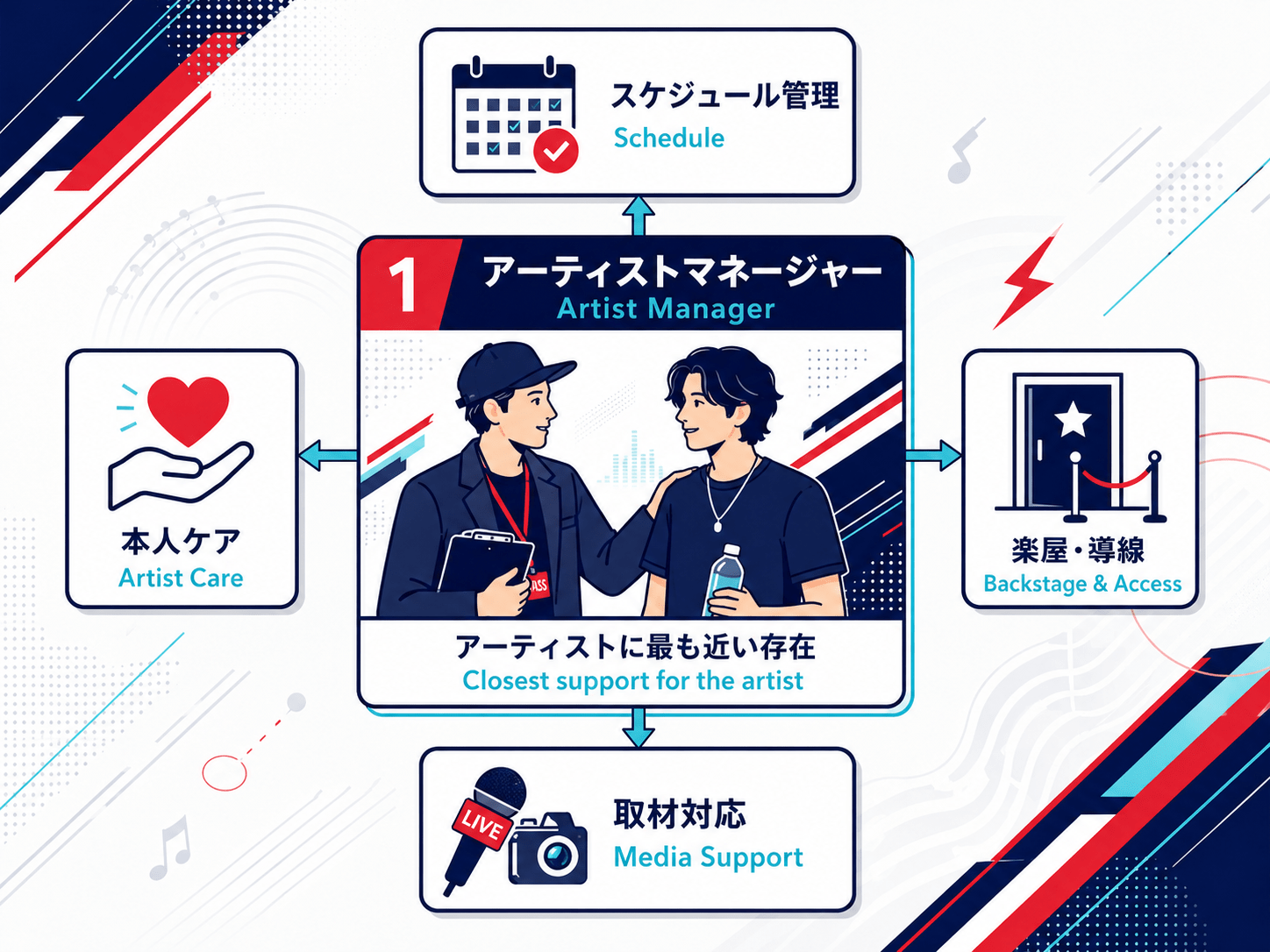
The artist manager is one of the people closest to the artist.
During a tour, they manage and support the artist’s schedule, health condition, interviews, photo shoots, meet and greets, dressing room environment, media activity, and communications with related parties.
Their work may include:
・Managing the artist’s schedule
・Checking dressing rooms, meals, and rest time
・Handling interviews, photo shoots and meet and greets
・Communicating with promoters and organisers
・Confirming the artist’s requests and preferences
・Supporting the artist before and after the show
・Checking social media and media-related activities
・Working with hair and make-up stylists and content teams
The artist manager’s role is to help create an environment where the artist can focus on the performance.
On an overseas tour, artists may face language barriers, cultural differences, jet lag, unfamiliar food, long travel days and sudden changes on site.
The artist manager keeps an eye on the artist’s condition and works closely with the tour manager and production manager to keep the tour running smoothly.
For a solo artist, one artist manager may be enough. For bands, groups, voice actors, idols, or artists with heavy media schedules, there may be one or two managers, or sometimes even more.
Tour Manager
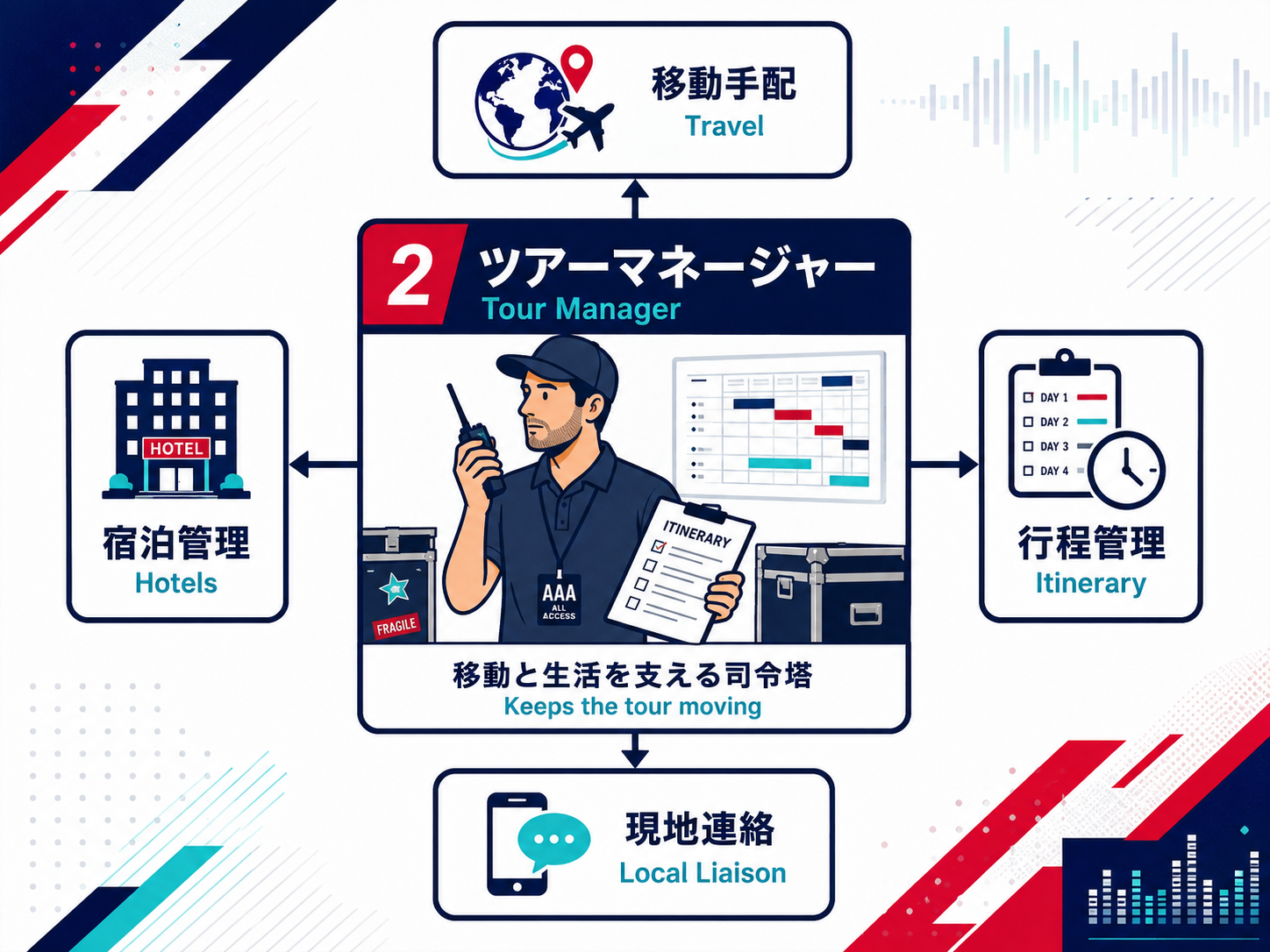
The tour manager is responsible for managing the general movement, accommodation, schedule and day-to-day flow of the tour.
Their work may include:
・Checking flights, hotels and vehicles
・Managing call times and travel times
・Overseeing the movement of artists and staff
・Communicating with local promoters and venues
・Checking meals, rest time and dressing room arrangements
・Resolving problems on the fly・Preparing for travel to the next city
The tour manager is the person who keeps the tour’s movement and daily activities on track.
For example, they need to know what time the artist leaves the hotel, what time the team needs to arrive at the airport, who is travelling in which vehicle, when the team enters the venue, and how much rest time is available after rehearsal.
If these details fall apart, the whole tour can be affected.
On an overseas tour, flight delays, traffic, immigration, baggage issues and jet lag can all create unexpected problems.
The tour manager needs to stay on top of all these by always looking at the full picture and thinking several steps ahead.
Therefore, the tour manager does not simply oversee just the show itself, but has to keep a close eye on airports, hotels, vehicles, dressing rooms, meals, rest times, and the movement of the entire touring party at all times as well.
Production Manager
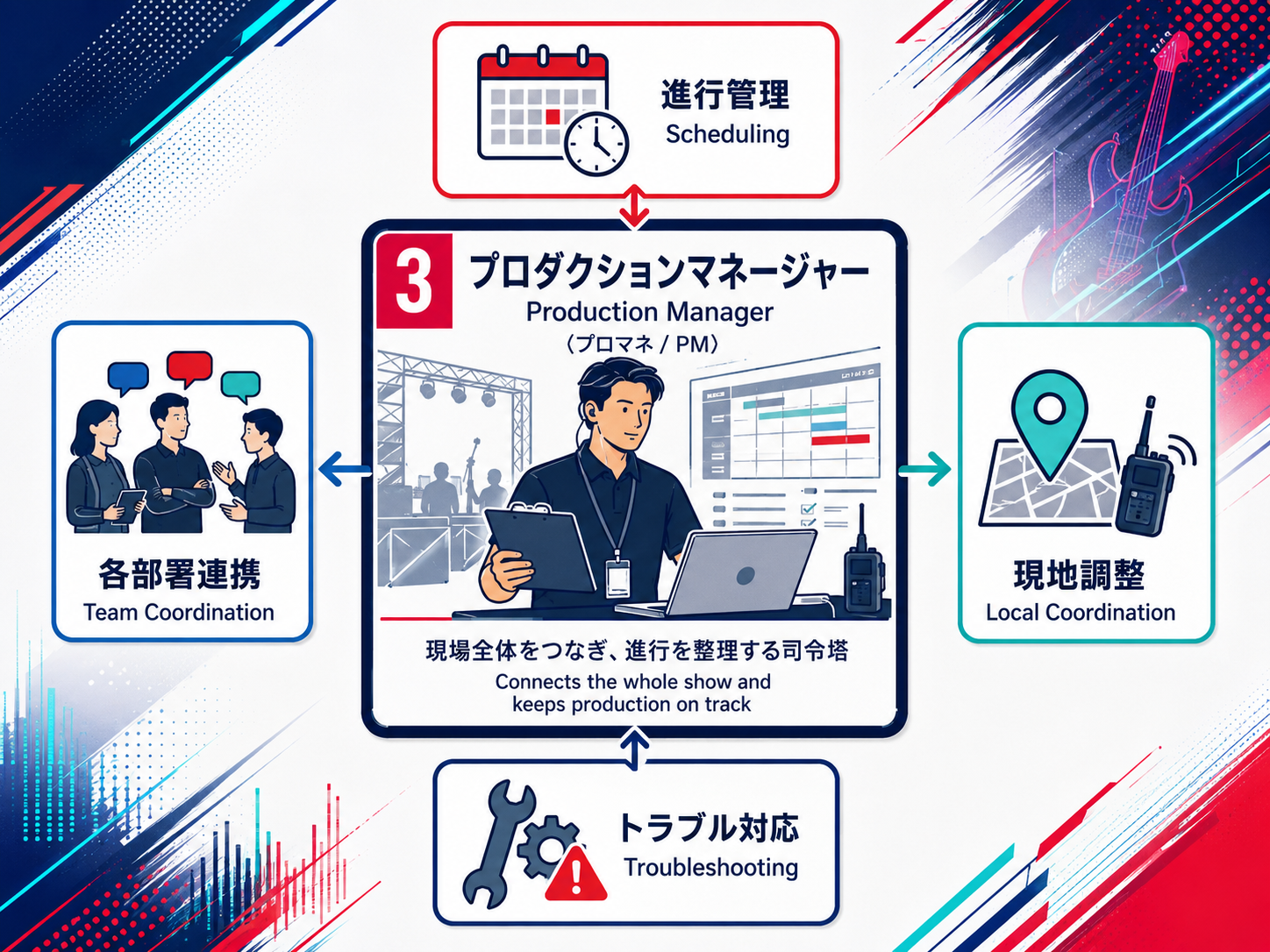
The production manager is responsible for the production and technical side of making the live show happen.
Their work may include:
・Checking venue specifications
・Sharing technical riders
・Confirming audio, lighting, video and power requirements
・Checking stage size and loading access
・Creating production schedules
・Managing load-in, rehearsals, show times and load-out
・Coordinating with local technical teams
・Bridging gaps between the Japanese team and the local team
If the tour manager is the one who looks after people and movements, the production manager would be the one who looks after the stage and the on-site production in like manner.
On overseas tours, every venue is different.
A piece of equipment that is standard in Japan may not be available locally. Even equipment with the same name can have different specifications. Loading access, working hours, power supply, rigging options and crew rules can all vary from venue to venue.
In some countries and regions, local crew responsibilities, working hours and additional cost structures may also be different from what Japanese teams are used to.
The production manager checks these details in advance and helps translate the artist’s requirements into something that can actually work within the local venue and production environment.
In overseas touring, the production manager is both a technical translator and the person who keeps the production traffic moving.
Technical Crew
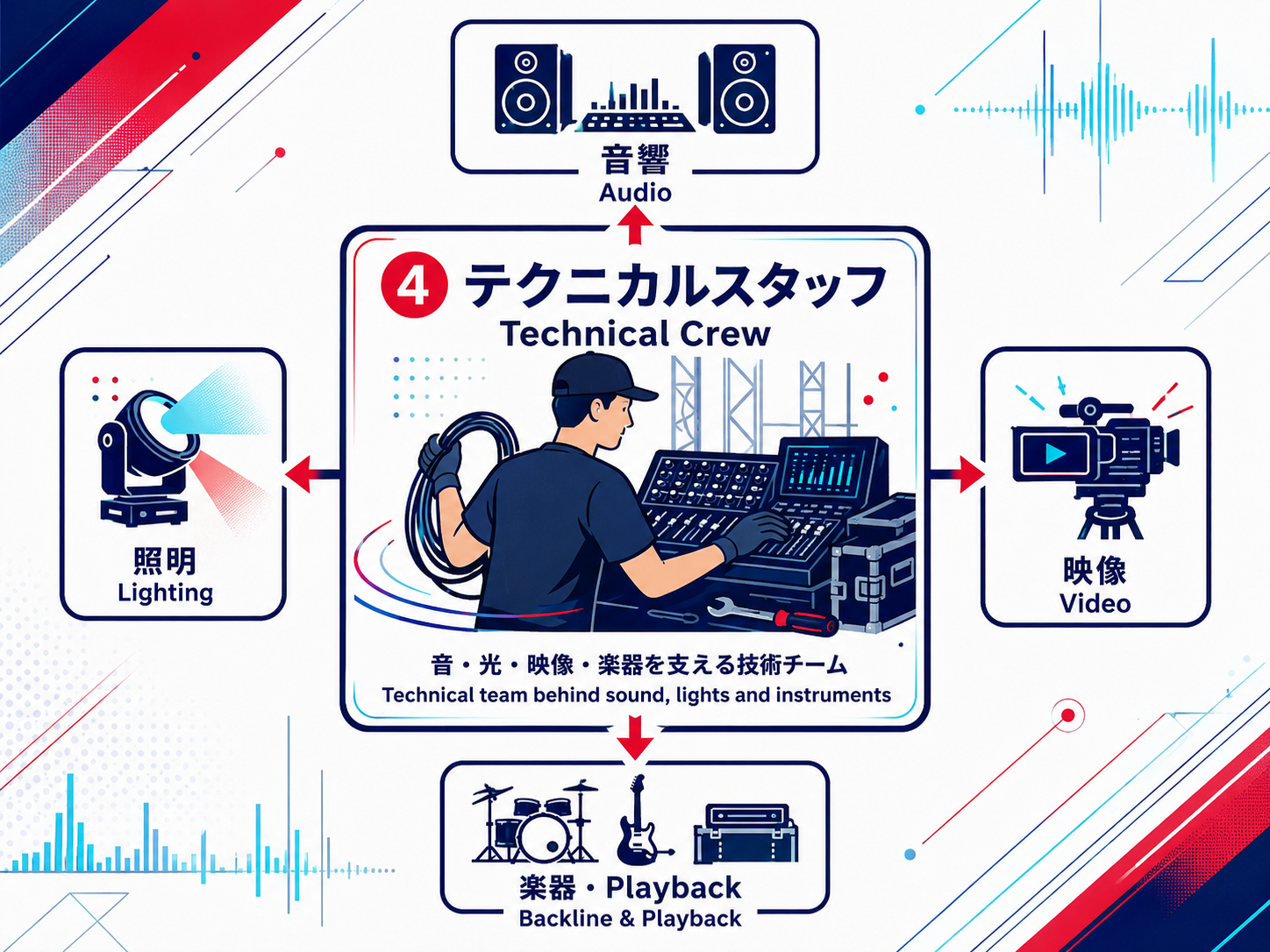
Technical crew is a general term for the people who support the technical side of a live show, including sound, lighting, video, instruments, and playback.
They help create the environment the artist needs to perform with confidence, while making sure the audience experiences the sound, light and visuals as intended.
Depending on the size and style of the tour, the exact type and number of technical crew members may change, but they are essential to keeping the quality of the live show stable from venue to venue.
Front of House Engineer
The FOH engineer, or Front of House engineer, is responsible for the sound the audience hears.
They operate the mixing console from the front of house position, usually located in the audience area or at the back of the venue, and mix vocals, instruments, playback, and other sound sources into the overall live audio feed.
Different venues can have a discernible effect on how sound is carried to the audience, even if the artist remains the same.
The height of the ceiling, the wall materials, the shape of the room, the speaker system, and the number of people in the audience can all change how the sound is being heard.
Bringing an FOH engineer who has a solid understanding of the artist’s sound along with the tour makes it easier to keep the sound output consistent across different countries and venues.
For bands in particular, FOH is one of the most important touring positions because it directly affects how the show feels to the audience.
Monitor Engineer
The monitor engineer is responsible for the sound the artist hears on stage.
While the FOH engineer creates the sound for the audience, the monitor engineer creates a sound environment that makes it easier for the artists to perform well.
This may include helping the vocalist hear their own voice clearly, making sure the drummer can hear the click track, or adjusting the balance so that each musician can hear the other instruments they need.
Many artists now use in-ear monitors, often called IEMs, instead of traditional stage monitor speakers.
If a band uses IEMs in detail, or if the artist has very specific preferences for what they want to hear through the monitors on stage, a monitor engineer may travel with the tour.
Instrument Tech
Instrument techs look after the instruments used by the artists, including guitars, basses, drums, keyboards and related equipment.
Their work may include:
・Tuning guitars and basses
・Changing strings
・Checking pedalboards and sound effects
・Checking amplifiers and cables
・Setting up drum kits
・Checking keyboard connections
・Preparing backup equipment in case of emergencies
On an overseas tour, instruments and equipment can be affected by accidental knocks while traveling, vibration, humidity, temperature, and different power environments.
Equipment that worked perfectly the day before may suddenly develop a problem in the next city.
Instrument techs find and solve those issues before they reach the stage. Their job is to make sure the artist can perform in the usual frame of mind and confidence level.
They play a key part in protecting the integrity of the performance.
Playback Operator
The playback operator is responsible for playback tracks, click tracks, sound effects, timecode and other elements that may be linked to the show.
Many modern live shows feature more than just live instruments.
They may also include click tracks, sound effects, synth layers, backing vocals, video-linked audio, timecode for lighting or video, and other programmed elements.
If playback stops, the song may not be able to start. Video and lighting may fall out of sync. The timing of the show may be affected.
For bands and artists that rely on playback, or shows with video and lighting linked to timecodes, the playback operator is an extremely important role.
They may not be visible to the audience, but they support the time structure of the live show.
Lighting Operator
The lighting operator controls the lighting during the show.
Lighting is one of the key elements that creates the atmosphere of a live performance.
It can be used to change colours for each song, brighten the stage during the chorus, create a blackout between scenes, or as a key lighting cue exactly when the artist enters or the music changes.
For smaller overseas shows, local venue lighting staff may operate the lights.
However, if the show has detailed lighting cues, or if it is important to reproduce a particular visual world across different venues, a lighting operator may travel with the tour.
Lighting crew is especially essential for hall tours, arena shows, and artists with a strong visual identity.
Video Operator
The video operator handles LED screens, projectors, camera feeds, VJ materials and other visual elements.
If the video setup is simple, the local team may be able to handle it. However, when video is a major part of the show, or when visuals are linked to sound, lighting, or timecode, a video operator may travel with the tour.
Their role can include playing different video materials for each song, displaying background visuals on LED screens, sending live camera feeds to the screen, operating VJ content, or syncing video to timecodes.
Video can have a major impact on how the audience experiences the show.
On overseas tours, LED screen size, resolution, input methods and video systems can vary greatly from venue to venue.
That is why advance checks and show-day support by the video operator are so important.
Merchandise Manager
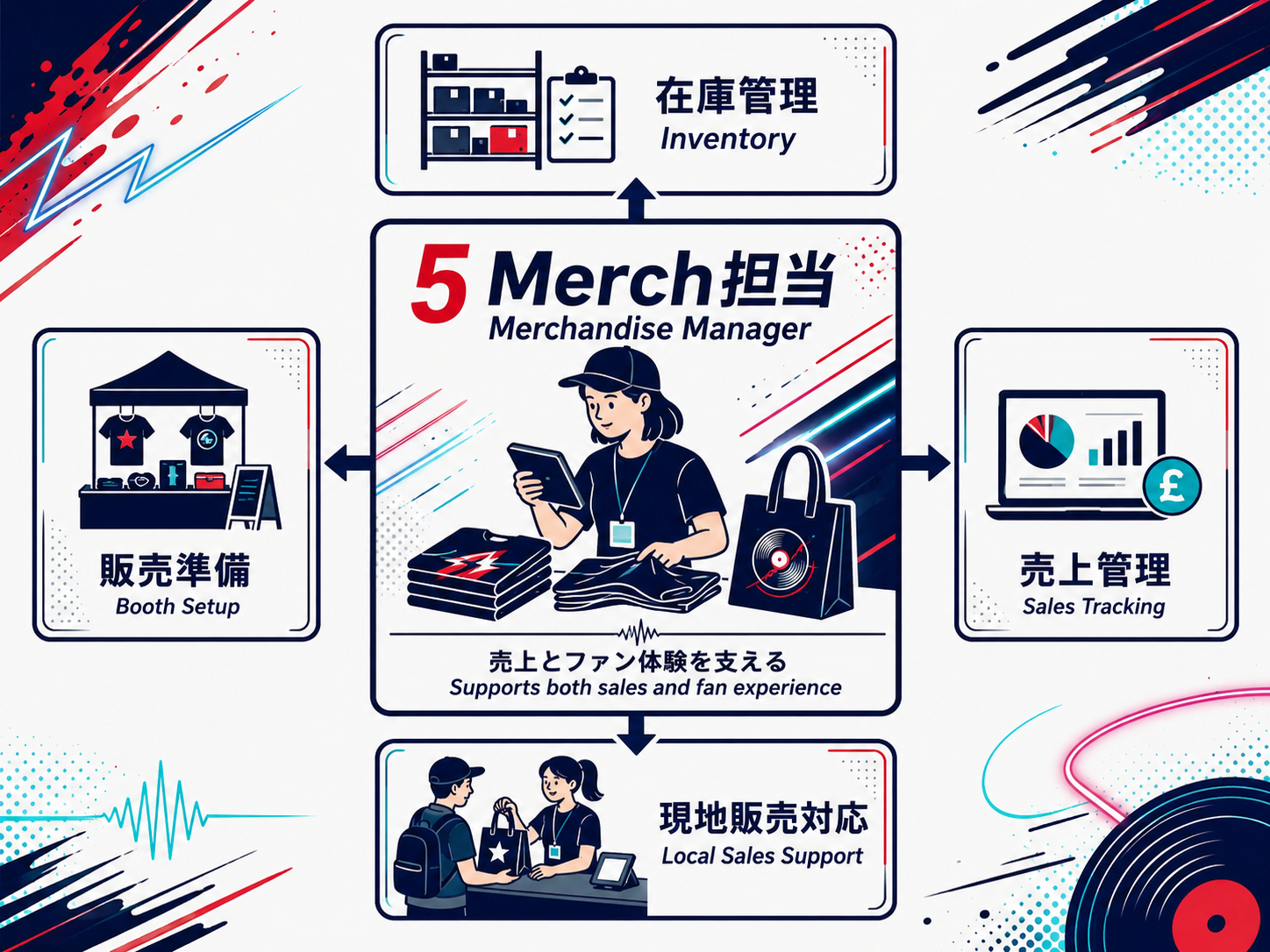
The merchandise manager handles tour merchandise sales and stock management.
T-shirts, towels, posters, vinyl records, CDs, stickers and other items sold at the venue are both important souvenirs for fans and an important part of the tour’s income.
Their work may include:
・Managing merchandise stock
・Checking the sales booth setup
・Preparing price lists and product displays
・Briefing local sales staff
・Managing sales records
・Checking cash and card payments
・Checking stock after the show
・Preparing merchandise for transport to the next city
Merchandise can be especially important on overseas tours.
In many markets, fans are very used to buying merchandise at live shows, and merch sales can become a major part of the overall tour revenue.
At the same time, there are many things to ascertain before the tour can start selling merchandise at an overseas venue.
Venue commission, payment methods, local currency, tax, sales staff, booth location, post-show sales time, and moving stock between countries all need to be managed.
The merchandise manager is thus more than just a salesperson. They play a key role in supporting and enhancing both fan experience and tour revenue.
Hair & Make-up
Hair and make-up artists, as the name suggests, are responsible for the performer’s hair and make-up.
They may provide support not only during the live show itself, but also in interviews, photo shoots, meet and greets, VIP activity, livestreams, social media content, and other promotional works.
On an overseas tour, travelling, jet lag, and climate differences can all affect the artist’s condition and appearance.
Stage lighting and camera settings can also change how the artist looks on stage or on screen.
Having hair and make-up support on tour makes it easier to keep the artist’s visual image consistent across different countries and venues.
This role is especially important for artists with a strong visual identity, tours with frequent photo or video content, and shows with heavy media activity.
Stylist
The stylist manages the artist’s outfits and overall visual presentation.
This can include stage costumes, outfits for photo shoots, interview looks, shoes, accessories, and other visual details.
Their work may include:
・Preparing outfits
・Checking costumes for each show
・Managing shoes and accessories
・Checking outfits for interviews, photo shoots, and meet and greets
・Doing final checks before the performance
・Responding to costume problems
On tour, costumes have to travel from city to city.
They may become wrinkled, damaged, or difficult to use in a particular climate or venue environment.
The stylist supports the artist’s world visually and helps maintain a consistent image throughout the tour.
Wardrobe
Wardrobe staff are responsible for the practical management of costumes and clothing.
If the stylist focuses on the overall visual concept, wardrobe staff help make that concept work in real life during the tour.
Their work may include:
・Storing costumes
・Steaming outfits
・Managing laundry and cleaning
・Supporting quick changes during the show
・Managing shoes, accessories and small costume items
・Handling emergency repairs or stains
For large tours, or shows with many costume changes, wardrobe staff may be included in the touring team.
For smaller tours, the stylist, manager, or artist may handle some of these tasks themselves.
It is not always a highly visible role, but a properly managed wardrobe can directly affect the artist’s comfort level and stage presentation.
Photographer
The photographer captures live photos and does tour documentation.
They may do so not only during the show itself, but also for rehearsals, backstage moments, travel scenes, fan interactions, and local scenery.
The photos can be used for social media, official websites, fan clubs, press releases, tour records, and future promotional materials.
Today, photos are often shared very quickly after a show, so photographers can play an important role in how the tour is communicated to fans.
They help capture the energy of the tour and turn each show int
Videographer
The videographer captures video content from the tour.
This may include live footage, backstage scenes, travel moments, interviews, short-form social media videos, YouTube content, or tour documentary material.
A video operator handles the screens and video systems used within the live show.
A videographer, on the other hand, shoots the actual video content for records, promotion, and storytelling.
Their work helps share the atmosphere of the tour with fans who could not attend in person, while also preserving important moments in the artist’s journey.
Interpreter
The interpreter supports communication between the Japanese team and local staff, promoters, venues, media, and other parties.
On overseas tours, English is often used as the main working language.
However, depending on the country, other local languages may also be needed.
Their work may include:
・Supporting communication with local staff
・Interpreting interviews and media activity
・Supporting meet and greets or VIP activity
・Interpreting technical meetings
・Helping explain problems or requests on site
If the artist and Japanese staff can communicate comfortably in English, a dedicated interpreter may not always be necessary.
However, when details and nuance matter, having an interpreter can make the site run much smoother.
This is especially true for interviews, fan-facing activity, and problem-solving on site, where small misunderstandings can quickly turn into bigger issues.
Local Coordinator
The local coordinator is someone who understands the country or city being toured and supports local arrangements and communication.
Their work may include:
・Communicating with local promoters and venues
・Checking vehicles, hotels, meals, and supplies
・Coordinating with local staff
・Supporting local rules, culture, and customs
・Responding to sudden changes or issues
・Supporting interpretation and artist liaison work when needed
On overseas tours, having someone who understands the local area can make a huge difference.
For example, where can the team buy urgent supplies? What is the traffic like? Can food be delivered to the venue? Are there local holidays or road closures that may affect the schedule?
These details can be solved much faster when there is someone with local knowledge available for consultation.
The local coordinator is a local guide for the production.
Local Runner
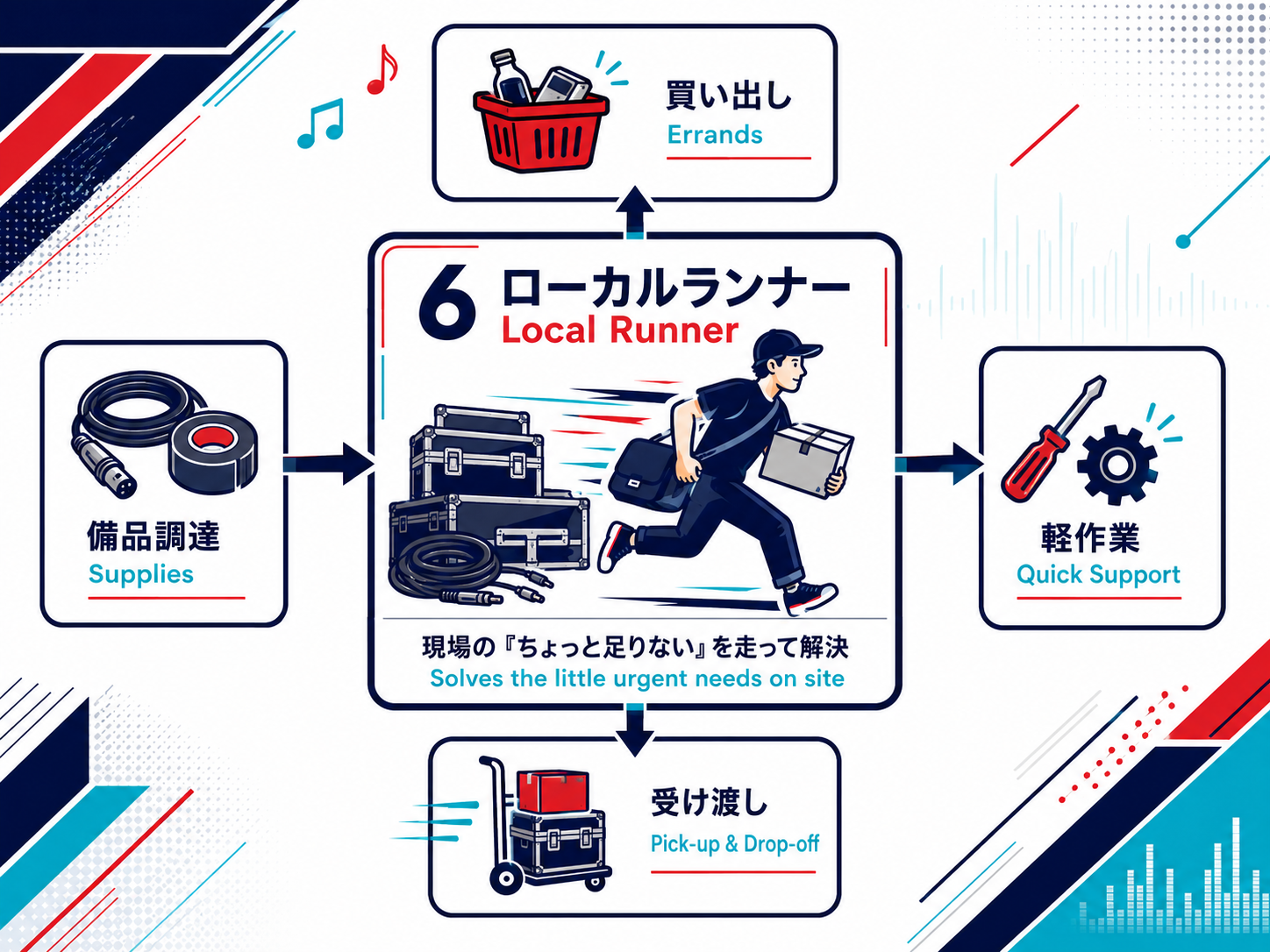
A local runner supports the site by handling errands, supply runs, small deliveries, and practical on-site tasks.
As the name suggests, they are often the person running around to keep things moving.
Their work may include:
・Buying supplies
・Preparing drinks and snacks
・Arranging for printing, stationery, or small office items
・Going to pharmacies or supermarkets
・Finding small technical items such as adapters, batteries, or tape
・Helping with handovers of vehicles or luggage
・Attending to simple artist or staff needs
・Handling small practical tasks inside or around the venue
On overseas sites, small items often go missing and sudden changes happen all the time.
There are not enough batteries.
An adapter is needed.
A printed document is missing.
More water is required.
Someone needs to go to the pharmacy.
Staff snacks are needed.
Tape or small cable accessories are suddenly required.
These may look like small issues, but if they are not solved quickly, they can affect the flow of the entire day.
The local runner solves these small urgent needs before they become bigger problems.
It is not the most visible role, but it is nevertheless extremely important for keeping the site moving.
Security
Security staff protect the safety of the artist, staff, audience, and venue.
The number of security staff needed depends on the artist’s profile, venue size, city, country, and fan activity.
Their work may include:
・Securing artist movement routes
・Managing dressing room and backstage access
・Checking safety during meet and greets or VIP activity
・Managing audience areas and queues
・Responding to problems inside the venue
・Supporting the artist’s exit after the show
In many cases, security is arranged by the local promoter or venue.
However, if an artist needs dedicated security, or if movement between locations requires additional safety support, security staff may travel with the tour.
Because safety rules and venue systems vary by country, it is important to confirm with security staff their responsibilities in advance.
Driver
Drivers transport artists, staff, and sometimes equipment from place to place.
Tours involve many different types of transportation, such as airport pickups, hotel-to-venue transfers, venue-to-hotel transfers, and travel to the next city.
Their work may include:
・Airport transfers
・Hotel and venue transfers
・Driving equipment vehicles
・Operating tour buses, vans, or sprinters
・Handling early morning or late-night movements
・Supporting luggage and equipment loading and unloading when required
Drivers are usually hired locally.
In Europe and North America, tours may use sleeper buses, sprinters, vans, or equipment vehicles for longer-distance travel.
Safe and punctual transport is essential to the whole tour.
If transport is delayed, load-in, rehearsal, interviews, show preparation and rest time can all be affected.
Drivers are thus another important role that keeps the tour moving.
Catering
Catering covers meals, drinks, and snacks for artists and staff.
Food may sound like a simple thing to obtain, but it is an important aspect to get right on an overseas tour.
When travelling, differing time zones and long working hours continue day after day, and not being able to eat properly can affect the artist’s performance and the team’s concentration.
Catering may include:
・Preparing drinks and snacks for dressing rooms
・Arranging meals for artists and staff
・Checking allergies and dietary restrictions
・Supporting vegetarian, vegan, halal, or other requirements
・Coordinating meal timings before and after the show
Catering may be arranged by the venue, the local promoter or the touring team.
Food culture and meal times can vary widely by country and region, so requests and dietary requirements should be shared in advance.
Food is more than just a break on tour. It is the fuel that keeps the tour going.
Who actually travels with the tour?

We have taken a brief look at a few different roles, but not all of them will travel with every tour.
The touring party depends on the artist, venue size, production scale, budget, show content, and local crew structure.
For many overseas tours, the following roles are often part of the travelling team:
・Artist manager
・Tour manager
・Production manager
・FOH engineer
・Instrument tech
・Playback operator
・Merchandise manager
The following roles may travel with the tour or be hired locally, depending on the scale and content of the production:
・Monitor engineer
・Lighting operator
・Video operator
・Hair and make-up artist
・Stylist
・Wardrobe staff
・Photographer
・Videographer
・Interpreter
・Local coordinator
・Security
・Driver
・Local runner
・Catering staff
A successful tour is not simply a matter of throwing more people into the different roles.
The real question to ask is: which aspect of the tour is more important, and who is needed to ensure its quality?
What can be handled by the local team?
Which areas need to be managed directly by the touring team?
Which roles are essential for the artist to perform with confidence?
These decisions play a major part in making a success of an overseas tour production.
A tour is built by a team
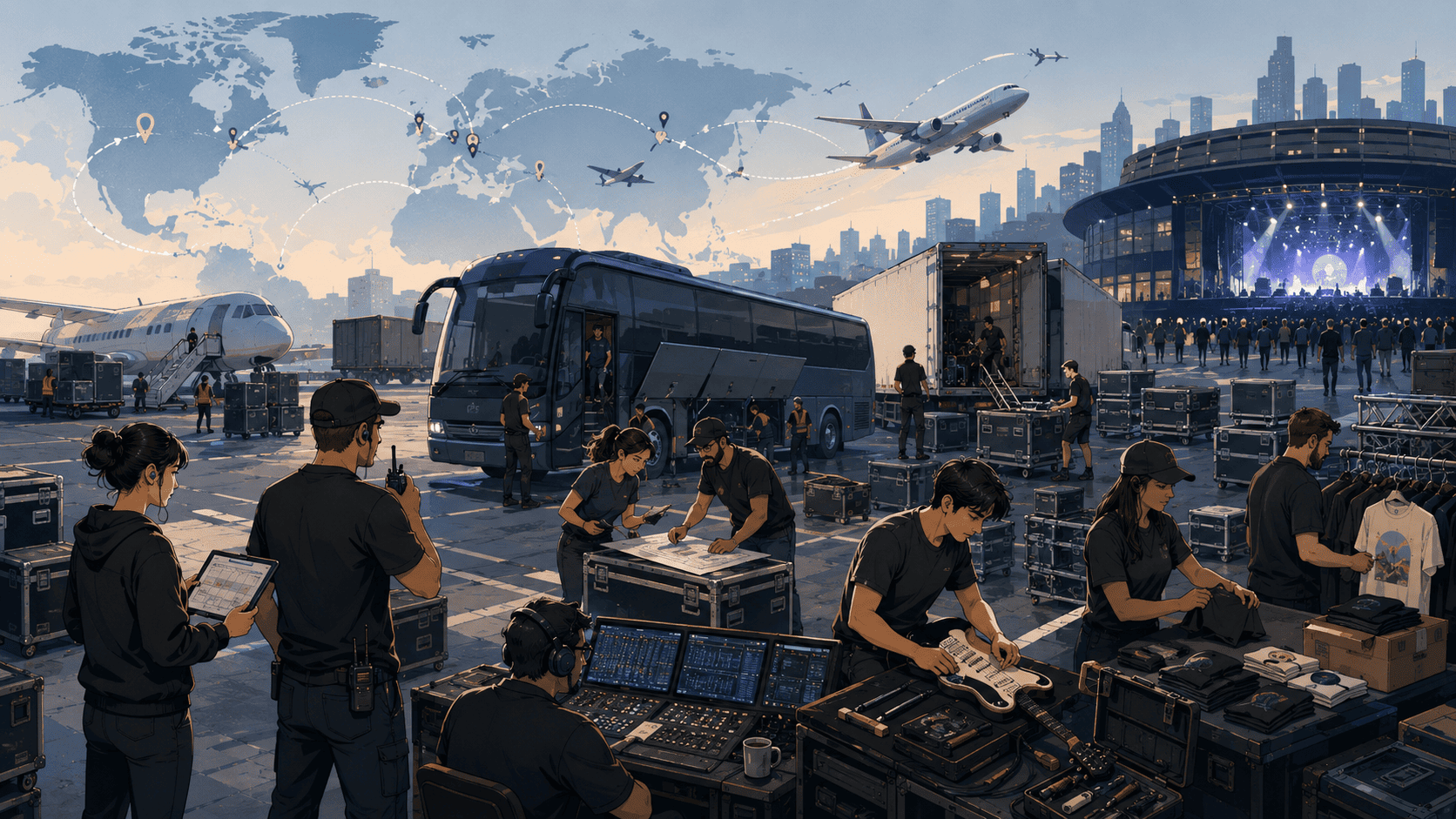
It’s true that the artist is the one who stands on the stage.
But many people are needed to make that stage possible in the first place.
The artist manager supports the artist directly.
The tour manager keeps travel and daily movements on track.
The production manager organises the venue and technical production.
FOH and monitor engineers create the sound.
Instrument techs ensure the gear is always ready.
The playback operator manages click tracks and show timing.
Lighting and video crew shape the visual world of the performance.
The merchandise manager enhances the fan experience and sales revenue.
Hair and make-up artists and stylists help maintain the artist’s visual presentation.
Photographers and videographers capture the energy of the tour.
Interpreters and local coordinators bridge language and local knowledge.
Local runners solve small urgent issues to keep the site moving.
An overseas tour certainly does not run on artists alone.
It only becomes possible when many specialists bring their skills together and keep things moving in the same direction.
Every day brings a different city, a different venue, and a different environment. Yet the goal remains the same: to deliver the same quality of live performance to the audience.
For that to happen, having a strong crew team working behind the scenes is essential.
An overseas concert tour is a journey that carries music across borders.
It is also a moving production site built by a team.
Tripleguns supports Japanese artists performing overseas by working with local promoters, venues, and technical teams to provide tour production, production management, venue coordination, and on-site support.
If you are an artist, management company, or promoter planning an overseas concert or world tour,
please feel free to contact us.