
The invisible infrastructure behind sound, lighting, and video
When people think of a live concert, they usually picture the artist on stage, the impressive sound system, the spectacular lighting, the large LED screens, and the enthusiastic energy of the audience.
But behind all of that, there is one essential element that keeps the entire show running.
Power.
Lights turning on.
Speakers producing sound.
LED screens displaying visuals.
Guitar amps coming alive.
Playback computers running.
Payment terminals working at the merchandise stand.
All of these rely on a stable and safe supply of power.
In live concert production, power is not just about “having enough sockets”. It encompasses the invisible infrastructure that supports the whole site, from sound and lighting and video to backline, playback, dressing rooms, merchandise, and communications.
For international artists performing in Japan, power supply specifications should be checked early. Japan mainly operates on 100V. Plug types, equipment compatibility, grounding, transformers, UPS, and responsibility boundaries can all affect how the show has to be managed.
Power is easy to overlook because it is mostly invisible. But when it stops working, everyone notices.
1. Where power is used on a live event site
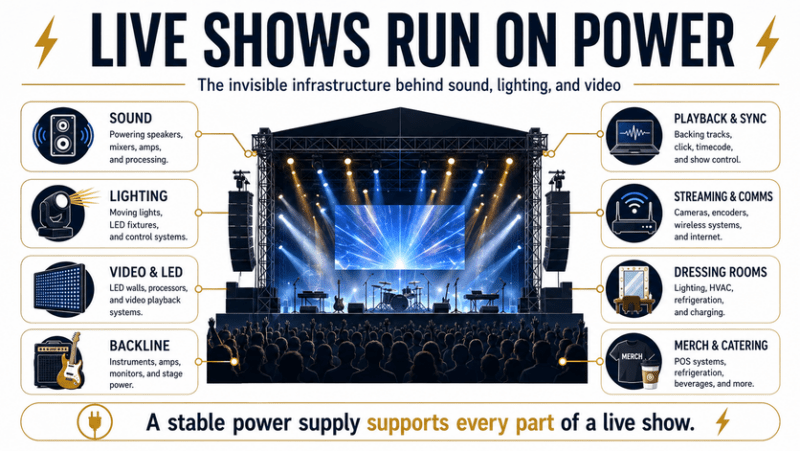
Power is not only used on stage.
At a live event or concert venue, power is usually needed for:
- Sound
- Lighting
- Video and LED screens
- Backline and instruments
- Playback and sync systems
- Streaming and communications
- Dressing rooms
- Merchandise and catering
This includes mixing consoles, speakers, guitar amps, effects pedals, keyboards, playback computers, LED screens, moving lights, routers, cameras, dressing room equipment, and payment devices.
In other words, power planning needs to cover the whole venue, not just the stage.
Why power matters when performing in Japan
For international artists and touring teams coming to Japan, power supply can be easy to overlook.
The reason is simple. Voltage and plug types differ from country to country.
Japan mainly uses 100V.
The UK and much of Europe use around 230V.
The US commonly uses 120V.
This means that equipment used overseas may not always work correctly in Japan without checking first.
For example, the following items should always be checked in advance:
- Guitar amps
- Bass amps
- Effects pedalboards
- Keyboards
- Synthesisers
- Samplers
- DJ equipment
- Audio interfaces
- Wireless systems
- IEM systems
- Playback computers and related devices
Just because the plug physically fits doesn’t mean the equipment can be operated safely or properly in Japan’s 100V environment, so it is essential to get this right before show day.
2. What international artists should check before performing in Japan
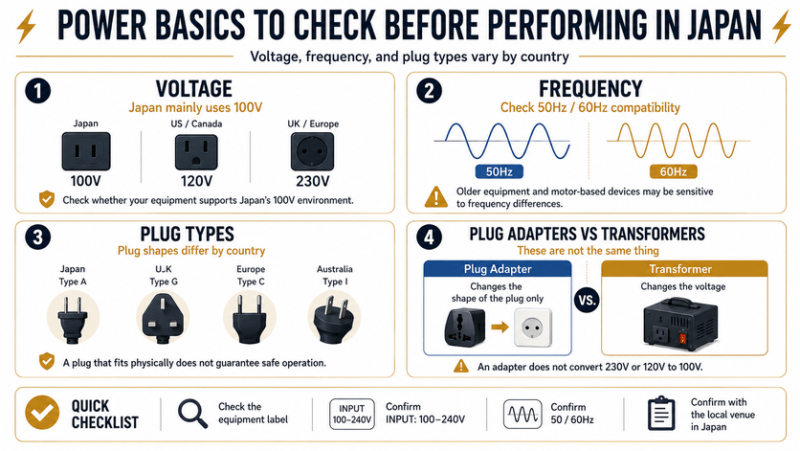
Before coming to Japan, international artists and touring teams should ascertain the power environment in advance.
Japan mainly uses 100V. The UK and much of Europe use around 230V, while the US commonly uses 120V. This means that equipment used overseas may not always work correctly in Japan without checking first.
The most important point to note is this:
A plug adapter only changes the shape of the plug. It does not change the voltage.
Even if the plug fits, the equipment may still not be suitable for Japan’s power supply.
Before the show, check:
- Does the equipment support 100V?
- Does the power adapter say something like – INPUT: 100-240V?
- Does the equipment support 50 / 60Hz?
- Do the plugs match Japanese outlets?
- Is a transformer required?
- Is the transformer capacity enough?
- Are the power strips safe to use in Japan?
- Is UPS required for playback, video, or network equipment?
- Who will provide the UPS?
- Who is responsible for power connection?
- Who should be contacted if there is a power issue?
- Should some backline equipment be rented locally in Japan?
For band equipment, pay special attention to:
- Guitar amps
- Bass amps
- Effects pedal power supplies
- Synthesisers and keyboards
- Samplers
- DJ equipment
- Audio interfaces
- Wireless systems
- IEM systems
- Playback computers
- Video playback computers
- Routers and communication equipment
It is also important to decide early what should be brought from overseas and what can be rented locally in Japan.
In some cases, renting equipment locally may be safer and more efficient than bringing everything from overseas.
3. Why a local production team helps
Power supply is not only a technical issue. It also involves venue rules, local working culture, safety requirements, and responsibility boundaries.
International teams usually need to know:
“Can this equipment be used in Japan?”
“What will the venue provide?”
“Do we need a transformer or UPS?”
“Who will be connecting us to the power supply?”
“Who should we contact if something goes wrong?”
A local production team can help organise these points clearly.
This may include checking venue specifications, confirming available power, coordinating with sound, lighting and video teams, arranging backline, checking transformers and power strips, and clarifying the contact point for issues on site.
From a production manager’s point of view, it’s important to acknowledge that not everything power-related has to be handled personally.
Collecting the right information, connecting to the right people, and reducing risks before the show can more often than not be the better way.
Conclusion: sort out power needs early for a successful show in Japan
A successful live show is not created only by what happens on stage.
Behind the music, lighting, video, instruments, playback systems, dressing rooms, and merchandise areas, there is always a need for reliable power.
For international artists performing in Japan, the key points to take away from this article are:
- Check whether your equipment supports Japan’s 100V environment.
- Do not assume simply bringing along a plug adapter is enough.
- Procure appropriate transformers, UPS and power strips in advance.
- Decide what to bring and what to rent locally.
- Clarify who is responsible for supplying power and who to contact if something goes wrong.
Live shows run on power.
And a good production site is one where that power flows safely, quietly, and reliably, so the artist can simply perform.
About Tripleguns(トリプルガンズ)

Tripleguns (トリプルガンズ) is a production team based in London, Singapore, and Tokyo, supporting Japanese artists and companies with international projects, as well as international artists and companies working in Japan and Asia.
We work across live concerts, world tours, exhibitions, and corporate events, providing production management, technical coordination, on-site support, logistics coordination, and facilitating communication between Japanese and local teams.
For international live production, language barriers may not be the only challenge you’ll face. Venue rules, technical standards, safety requirements, working culture, and responsibility boundaries can all be different from site to site.
Tripleguns acts as a bridge between international teams and the local production environment, helping each project run smoothly, safely, and professionally.
If you are planning a concert in Japan, an international tour, or an event production project, please feel free to contact us.