
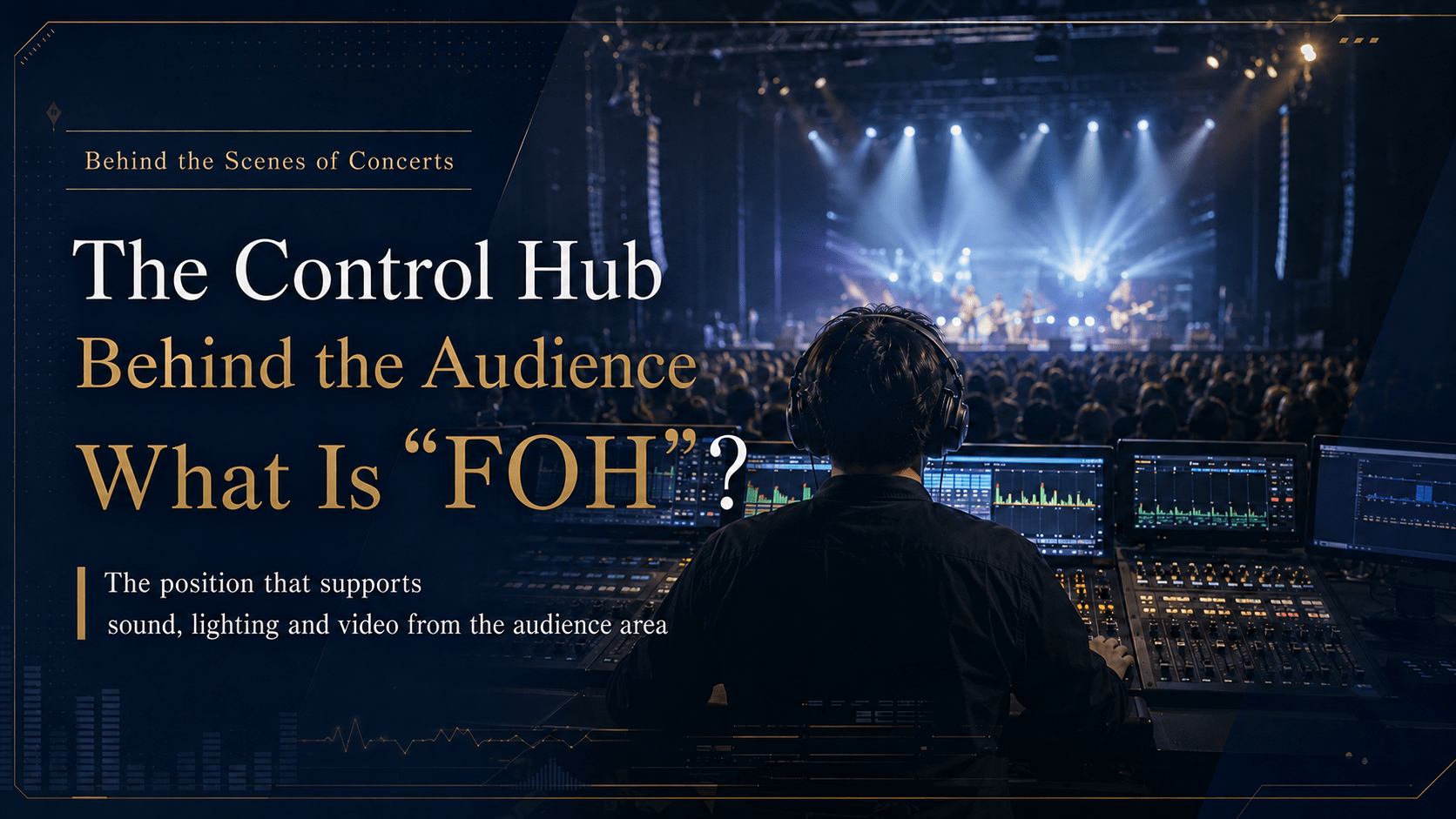
When you attend a concert, have you ever noticed an area in the middle or towards the back of the audience filled with equipment and production staff?
Large audio and lighting consoles sit alongside multiple monitors, while crew members keep their eyes on the stage and work continuously throughout the show.
In concert production, this area is known as FOH.
In our previous article, we introduced the crew members who travel with artists and support the logistics and production of international concert tours.
In this follow-up, we’ll be looking more closely at what happens inside the venue and explain how the team working from the audience side supports the performance from an operational area known as FOH.
FOH is often associated primarily with the sound team, but may also include lighting, video, camera, show-calling, and production personnel in reality.
A place for the performance and production created on stage to be shaped into the concert experience received by the audience.
That is the role of FOH.
What Does FOH Mean?
FOH stands for Front of House.
In theatres and event venues, the term may broadly refer to the public-facing areas used by guests, such as the lobby and auditorium.
In concert production, however, FOH usually refers to the operational area located within the audience space, where sound, lighting, video, and other technical elements are controlled.
In Japan, this area may also be referred to as the PA booth, PA desk or sound desk.
However, the term “PA booth” can sometimes refer specifically to the area occupied only by the sound team and audio equipment.
At many concerts, FOH includes not only sound engineers but also lighting, video, camera, and production personnel.
For this reason, when referring to the entire operational area within the audience space, the term FOH often describes its function more accurately.
Why Is FOH Located Within the Audience Area?
There is a practical reason why FOH is usually positioned in the middle or towards the rear of the audience.
The sound team needs to monitor the concert from a position that is reasonably close to what the audience is hearing.
On stage, musicians hear a mixture of acoustic instrument sound, stage monitors, and the main loudspeaker system.
The sound experienced by the artists on stage is therefore not the same as the sound heard by the audience.
From FOH, the sound engineer listens and makes real-time adjustments to the audio throughout the performance, checking points such as:
- Whether the vocals are clear
- Whether the instruments are properly balanced
- Whether the low frequencies are too powerful
- Whether the venue is producing excessive reverberation
- Whether the sound suits the mood and character of each song
Lighting, video, and camera teams also need a position from which they can see the full stage and any screens used in the production.
By viewing the stage from the same direction as the audience, the FOH team can accurately assess how the entire performance looks and sounds from the auditorium.
FOH Can Look Completely Different from One Show to Another
There is no single standard form for FOH.
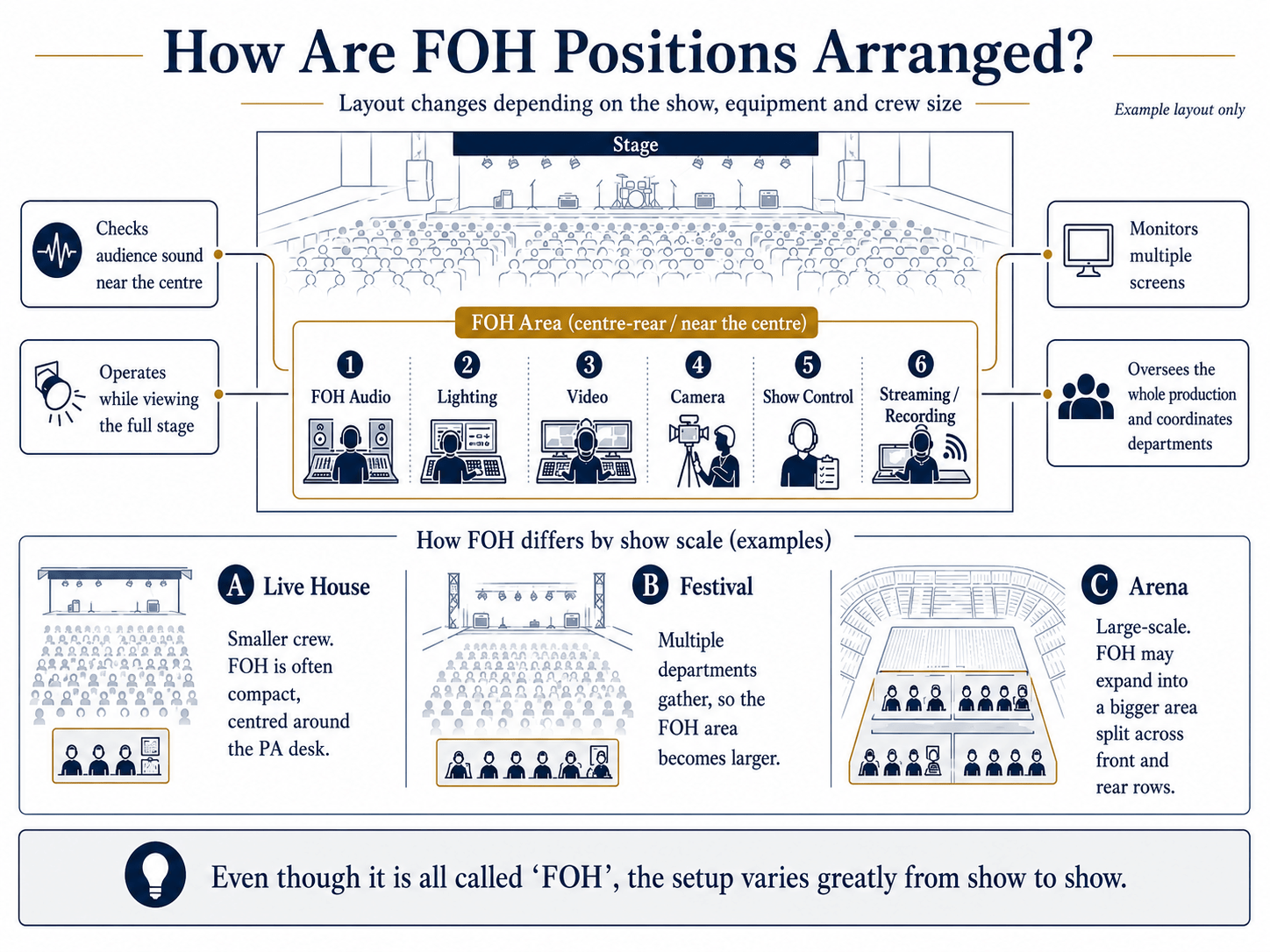
In a small live music venue, a compact sound desk and lighting console may be positioned at the back of the room and operated by only a few people.
At a festival, sound, lighting, video, camera, and show-control personnel may all work from the same designated area.
At an arena concert, the FOH compound may become a substantial technical zone that also accommodates broadcast, recording, special effects, lasers, and system-control teams.
The same term, FOH, can therefore describe very different setups.
At a small venue, it may consist of two compact consoles.
At a festival, it may resemble an island in the middle of the audience, occupied by several departments.
At an arena, it may become a large control area filled with equipment and operators working across multiple rows.
The size and composition of FOH depend not only on the venue capacity, but also on factors such as:
- The number of performers
- Whether video content is used
- Whether live cameras are required
- Whether the show is being streamed or recorded
- The size of the artist’s touring crew
- The structure of the local production team
FOH is therefore not a fixed space that exists in the exact same form at every venue.
It is a temporary operational area assembled for each show using the staff, equipment and systems required for that particular production.
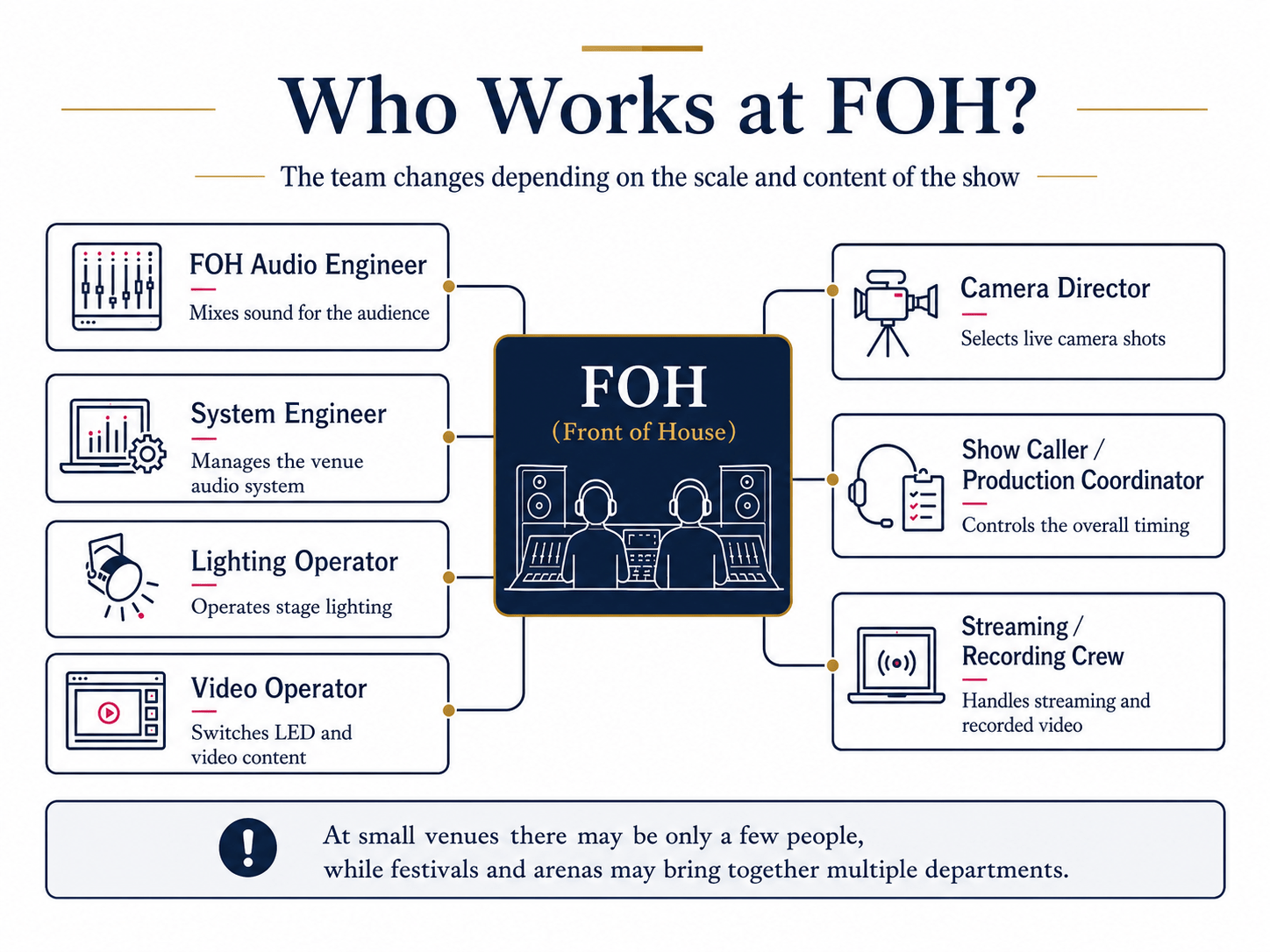
Who Works at FOH?
The number of people working at FOH, and their individual responsibilities, vary according to the scale and content of the production.
Below are some of the roles commonly found at FOH.
FOH Audio Engineer
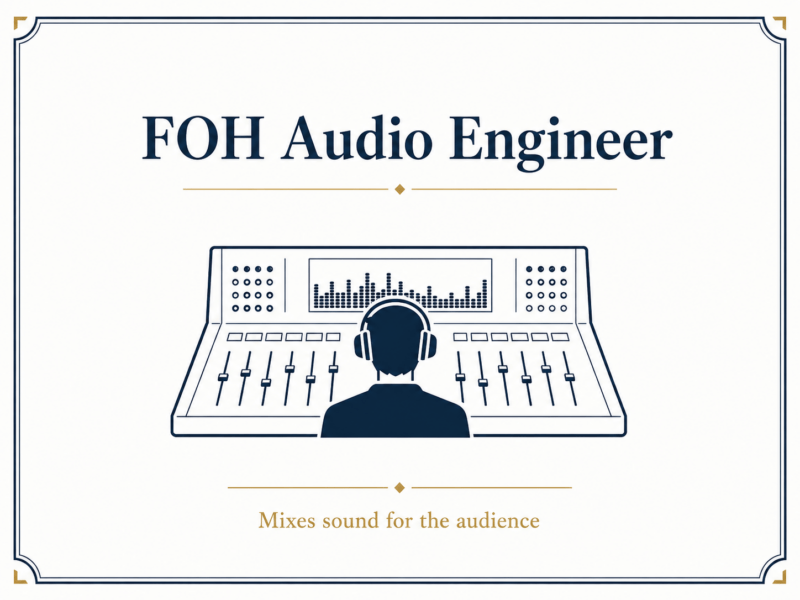
The FOH audio engineer creates the sound heard by the audience.
Vocals, guitars, bass, drums, keyboards, playback tracks, and other sound sources from the stage are sent to the mixing console.
The engineer adjusts the level and tonal quality of each source and combines them into a coherent mix.
The job involves much more than simply making sounds louder or quieter.
The engineer checks whether the vocals are being masked by the instruments, whether guitars and keyboards are competing for the same frequency range, and whether low frequencies are building up excessively within the venue.
Effects such as reverb and delay may also be used to create a sound that suits the atmosphere of the song and the artist’s creative identity.
On international tours, an artist may even travel with their own dedicated FOH engineer.
This engineer understands the artist’s music and preferred sound in detail.
System Engineer
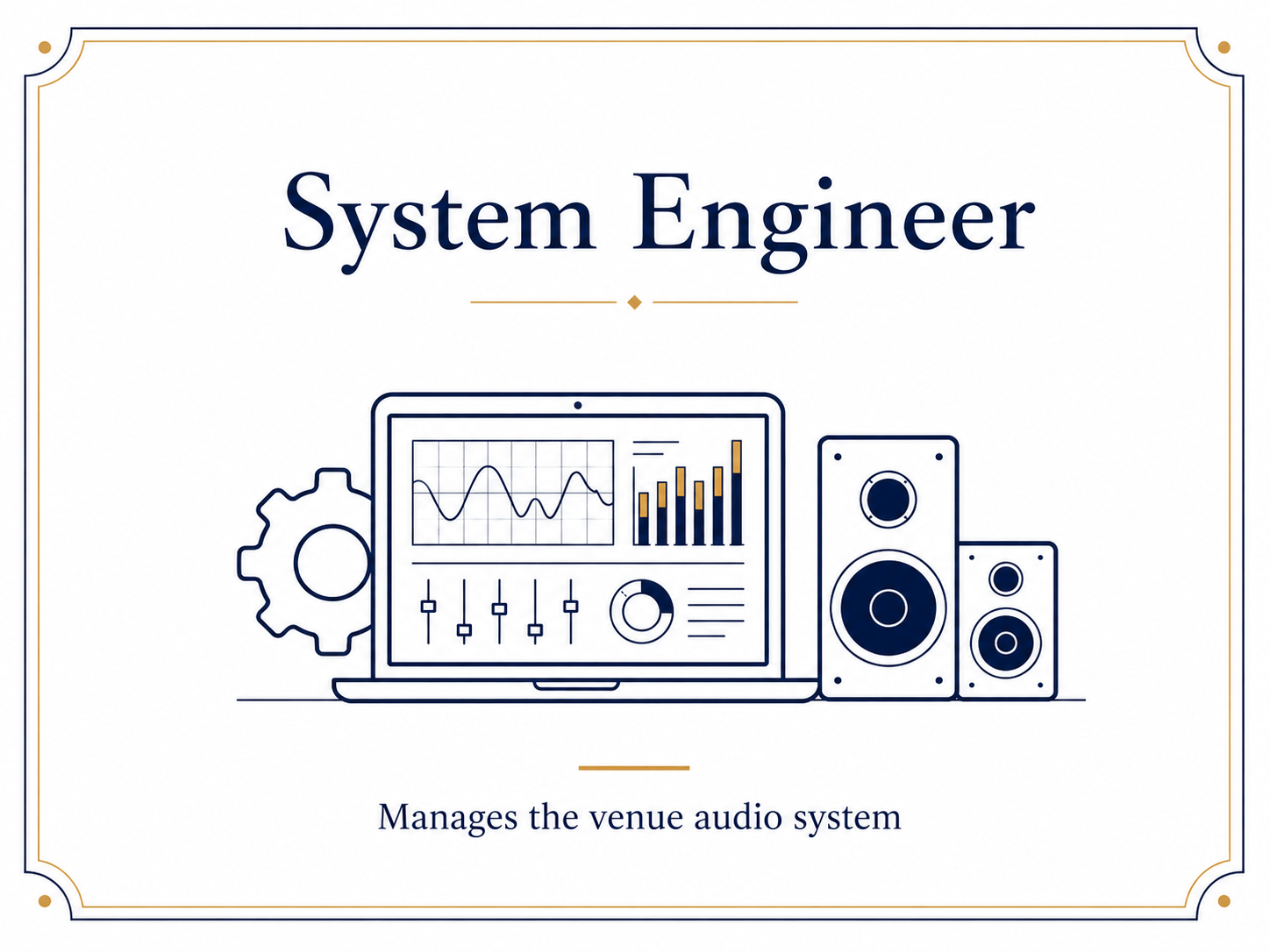
Large-scale productions may also have a system engineer working separately from the FOH audio engineer.
While the FOH engineer focuses on mixing the performance, the system engineer manages the loudspeaker system across the venue.
They adjust speaker positions, levels, timing, and system alignment to reduce major differences between the front, rear, sides and upper levels of the audience area.
Their role is to make the venue operate as one coherent audio system, reducing problems such as delayed sound in certain areas or excessive low-frequency energy in particular sections of the room.
Lighting Operator
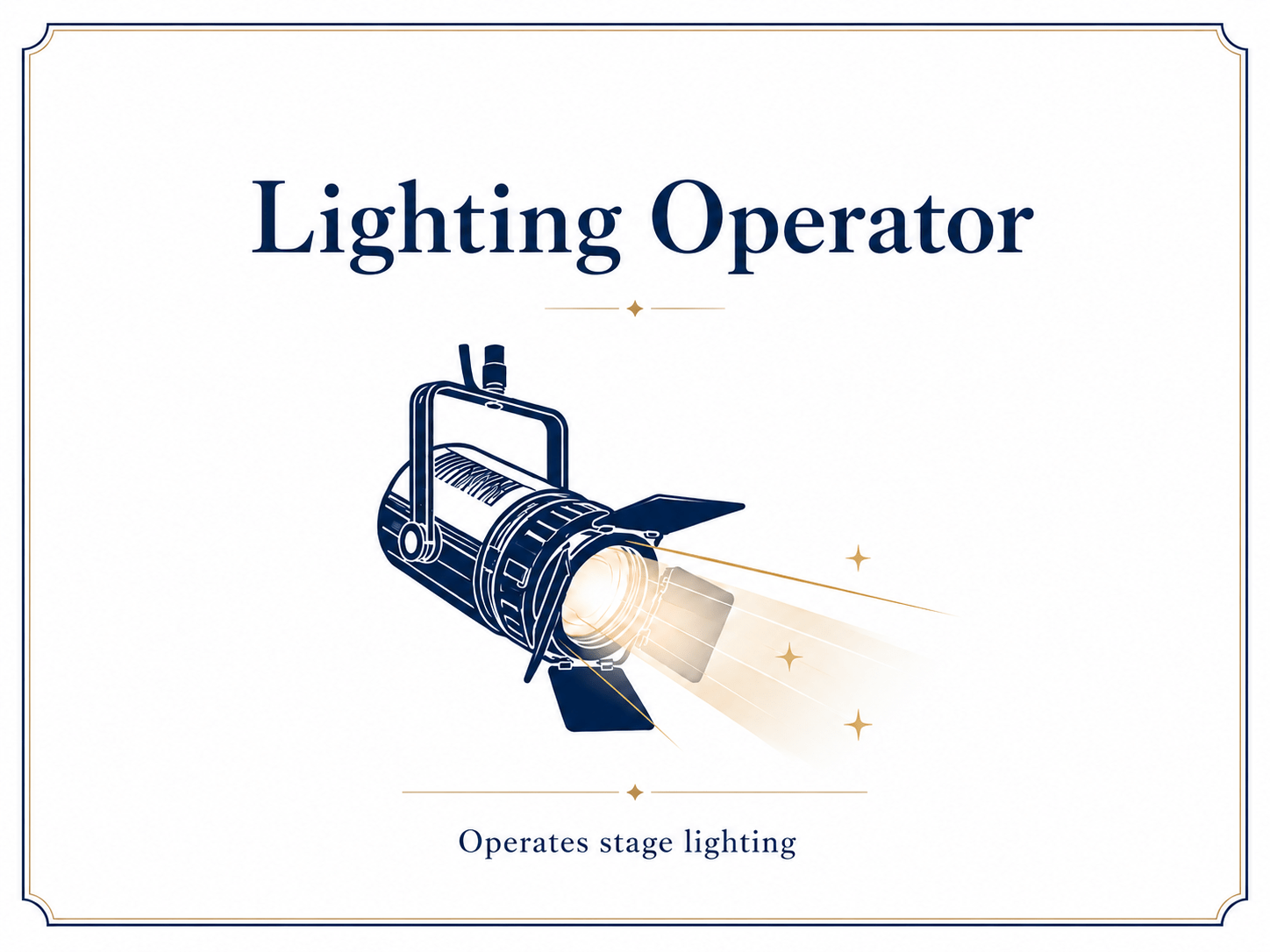
The lighting operator controls the stage lighting.
They adjust colour, intensity, direction, movement, and timing in response to the music and the production design.
Lighting does more than make the artist visible. It helps create the emotional atmosphere of each song.
For a quieter number, the lighting may be reduced and tightly focused. During a high-energy track, fixtures may move dynamically across the stage and audience.
The lighting may suddenly open up during a chorus or change as the artist enters the stage.
On major tours, lighting cues may be programmed in advance for every song.
At festivals and shorter appearances, the operator may instead work live, responding to the performance in real time.
A lighting operator must listen to the music while simultaneously following movement on stage.
The role therefore requires not only technical knowledge, but also the ability to understand the musical flow of a performance.
Video Operator

The video operator controls the content displayed on LED screens and monitors throughout the venue.
Concert productions may use a wide range of visual material, including:
- Artist logos
- Lyrics
- Profile images
- Event branding
- Sponsor content
- Opening videos
- Closing videos
- Visual content designed for individual songs
The video operator plays, stops, and switches this material at the correct moments in the programme or music.
When video content includes audio, close coordination with the sound team is also required.
For example, when the sound for an opening film is embedded in the video file, the video operator must start playback the same time the audio engineer sends the sound to the audience.
Even a delay of a few seconds can affect the impact of the production.
Careful preparation and communication between the sound and video teams are therefore essential.
Camera Director
When live camera footage is shown on large screens, a camera director may also work from FOH.
Several cameras are typically positioned around the venue, each capturing the stage from a different angle.
The camera director monitors these feeds and decides which camera feed should be displayed on the screen at any given moment.
When the vocalist is singing, the director may select a close-up of the singer.
During a guitar solo, the focus may switch to the guitarist.
When the audience is responding enthusiastically, the director may choose a crowd shot.
These decisions are made continuously in response to the performance and musical structure.
The live images seen by the audience are therefore created not only by the camera operators, but also by the director selecting and assembling the shots.
Show Caller and Production Coordinator
At festivals, awards ceremonies, corporate events, and other productions involving multiple performers or complex staging, a show caller or production coordinator may also be positioned at FOH.
The show caller gives cues to each department according to the overall running order.
These may include instructions such as:
- Fade the house lights
- Start the opening video
- Bring the presenter onto the stage
- Stand by the next artist
- Run the closing video
These cues are communicated to sound, lighting, video, camera, and stage teams.
Even when every department is highly skilled, the show will not come together unless everyone acts at the correct moment.
The show caller brings separate technical and production activities together onto a single timeline.
Streaming and Recording Teams
When a concert is streamed or recorded, a broadcast or recording team may work at FOH or in a nearby technical area.
The content shown on the venue screens is not necessarily the same as the programme seen by the online audience.
A livestream may require a separate combination of camera feeds, sound, subtitles, logos, advertisements, and other graphics.
At larger productions, the venue screen team and broadcast team may therefore operate from separate positions.
What Are Touring Crew and Local Crew?
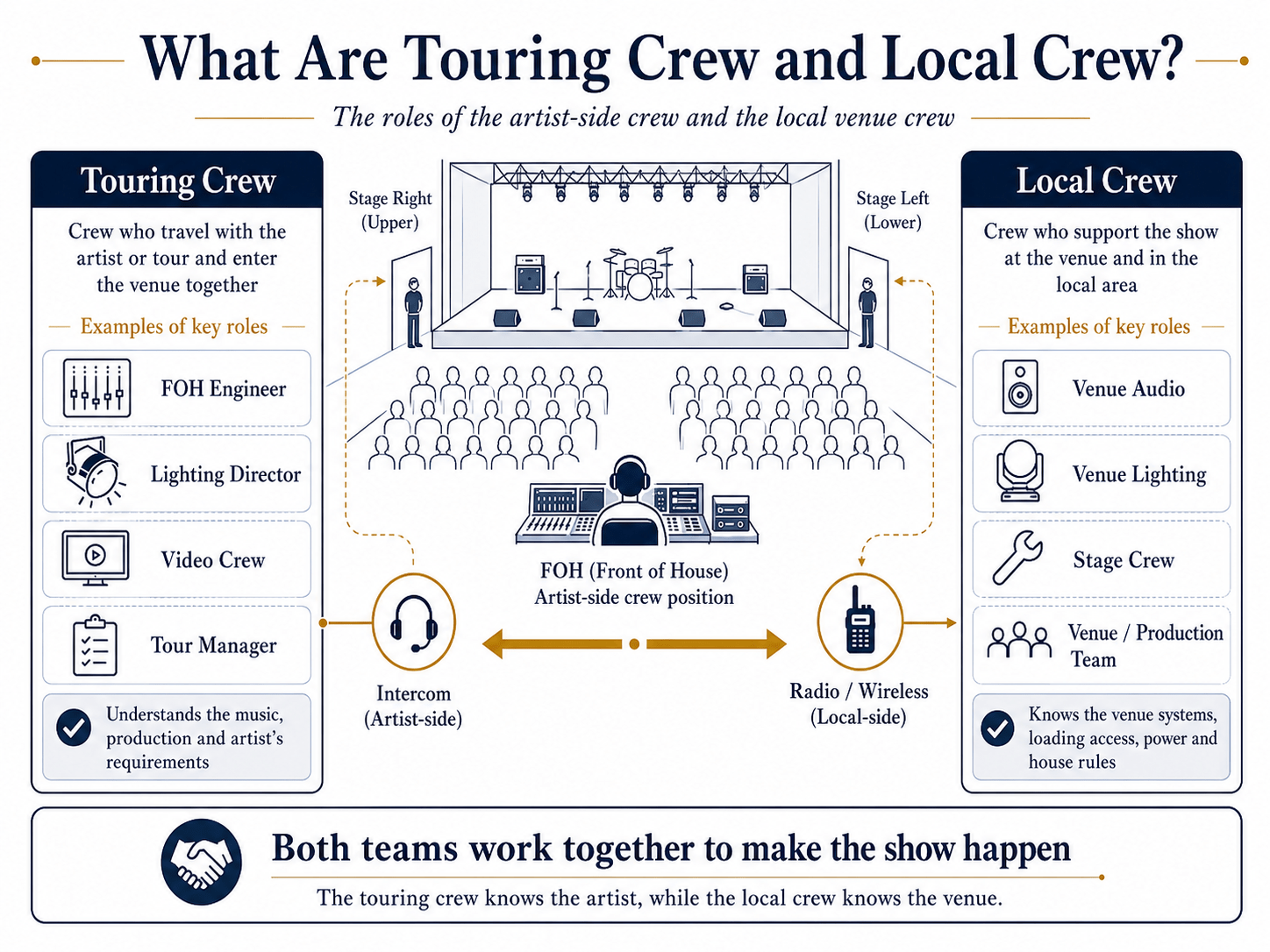
On concert productions, the staff working at FOH may broadly be divided into touring crew and local crew.
Touring Crew
Touring crew are the staff who travel with the artist or tour and enter each venue as part of the artist’s production team.
They may also be known as visiting crew or artist crew.
Examples include the artist’s FOH audio engineer, lighting director, video personnel, and tour manager.
Touring crew understand the music, production design, the artist’s preferences, and the overall structure of the tour.
Their main responsibility is to reproduce the artist’s intended quality and creative direction in a different venue each day.
Local Crew
Local crew are the staff who support the concert in the host country, city or venue.
They may also be known as house crew or venue crew.
Local staff understand the venue’s audio system, lighting equipment, electrical supply, loading access, and operating rules.
They support the visiting team by providing information such as:
- Which equipment is available
- Where power can be accessed
- How late the production is permitted to make sound until
- Where equipment should be loaded in
- How much audience space can be allocated to FOH
They also support the physical setup and operation of the production.
How Do Touring and Local Crews Divide the Work?
On an international tour, the touring crew does not necessarily travel with every piece of equipment required for the show.
In many cases, the venue or a local rental company supplies the audio and lighting consoles, loudspeakers, lighting fixtures, LED screens, and other systems.
The touring crew then uses this locally supplied equipment to reproduce the artist’s sound and production design.
For FOH audio, the division of responsibilities may look like this:
- The touring FOH engineer mixes the performance
- The local system engineer manages the venue loudspeaker system
- Local technicians support equipment connections and troubleshooting
For lighting, the structure may be:
- The touring lighting director defines the production design and cues
- The local lighting team prepares and operates the venue equipment
- Both teams confirm show-file compatibility and any differences between the planned and available fixtures
For video, the touring team may provide the visual content and creative instructions, while the local team manages the venue’s LED screens and playback systems.
The touring crew knows the artist.
The local crew knows the venue.
By combining that knowledge, both teams can deliver the production within a limited preparation period.
A Look at FOH During One Opening Sequence
From the audience’s perspective, the artist’s entrance and the start of the first song may appear to flow naturally.
Behind that short sequence, however, many people at FOH and backstage are working at the same time.
For example, when an artist enters after an opening video, the sequence may be:
- The stage team confirms that the artist is ready.
- The show caller puts each department on standby.
- The house lights fade.
- The video operator starts the opening film.
- The audio engineer sends the film’s sound to the audience.
- The stage lighting changes as the video ends.
- The stage team gives the artist the entrance cue.
- The artist enters and the performance begins.
- Sound, lighting, video, and camera teams begin operating simultaneously.
For the audience, this may last only a few seconds.
Behind the scenes, several departments are sharing the same timeline.
Even if just one person is a few seconds early or late, it may soften the impact of the production.
The more effortless a sequence appears, the more likely it is to be supported by careful preparation and precise coordination.
FOH and the Stage Wings Are Constantly Connected
FOH is not the only area supporting the concert.
Teams in the stage wings work directly with the artists and the equipment on stage.
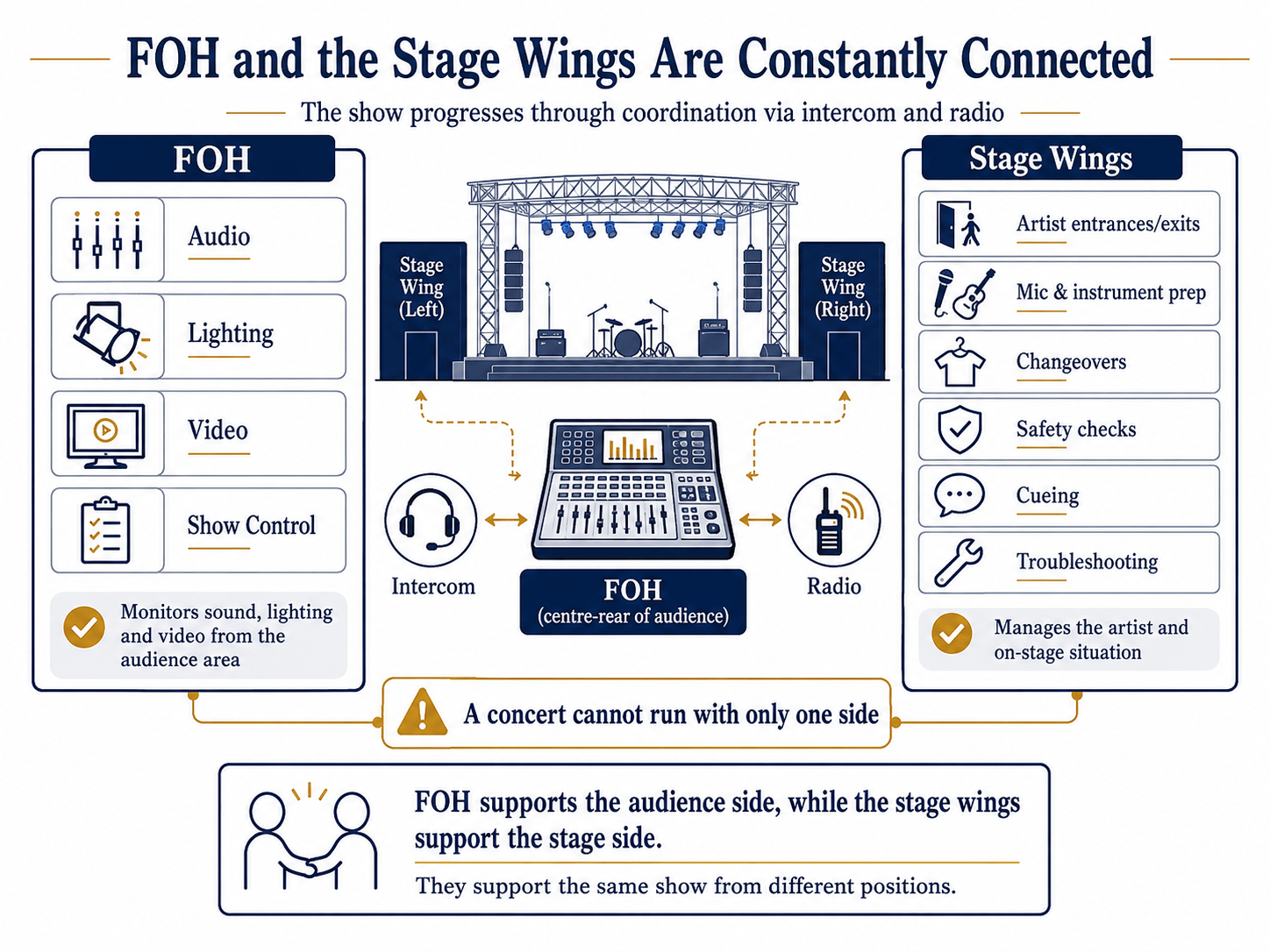
Their responsibilities may include:
- Managing artist entrances and exits
- Preparing microphones and instruments
- Carrying out equipment changeovers
- Monitoring stage safety
- Giving cues to performers
- Responding to technical problems during the show
FOH and backstage teams communicate continuously through intercom systems and radios.
If the FOH engineer hears a problem with a microphone, they may ask the stage team to check the microphone or cable.
If an artist is delayed backstage, the stage team informs FOH so that the timing of the video and lighting can be adjusted.
FOH monitors the sound, lighting, and video experienced by the audience.
The stage-wing team monitors the artists, equipment, and conditions on stage at close range.
By supporting the performance from different positions and remaining in constant communication, both teams keep the show moving.
FOH: Another Stage Within the Audience
The next time you attend a concert, take a moment before or after the performance to look towards the middle or back of the audience area.
You may see staff surrounded by audio consoles, lighting desks, and monitors watching the stage closely.
That FOH position may consist of only a small sound desk.
It may also be a large technical area occupied by dozens of people working across sound, lighting, video, camera, show control, and broadcast.
You may also see touring crew who travel with the artist working alongside local staff who understand the locality, venue, and technical systems.
While the audience focuses on the music, FOH continues to adjust the sound, lighting, video, and running of the production.
Its purpose is to deliver the performance created on stage to the entire venue.
To achieve that, FOH and backstage teams, touring crew, and local crew all work together to create a coherent concert.
Although it is rarely the focus of attention, FOH is a working environment located in the same space as the audience.
The next time you turn around during a live show, you may discover another stage operating behind you.
In our previous article, we introduced the crew members who travel with artists and support the logistics and production of international concert tours.
Tripleguns supports international performances by Japanese artists,
as well as overseas tours, concerts, events, and exhibitions.
